BAY 33
North American P-51 Mustang: Designed in 117 Days, Transformed by a Merlin
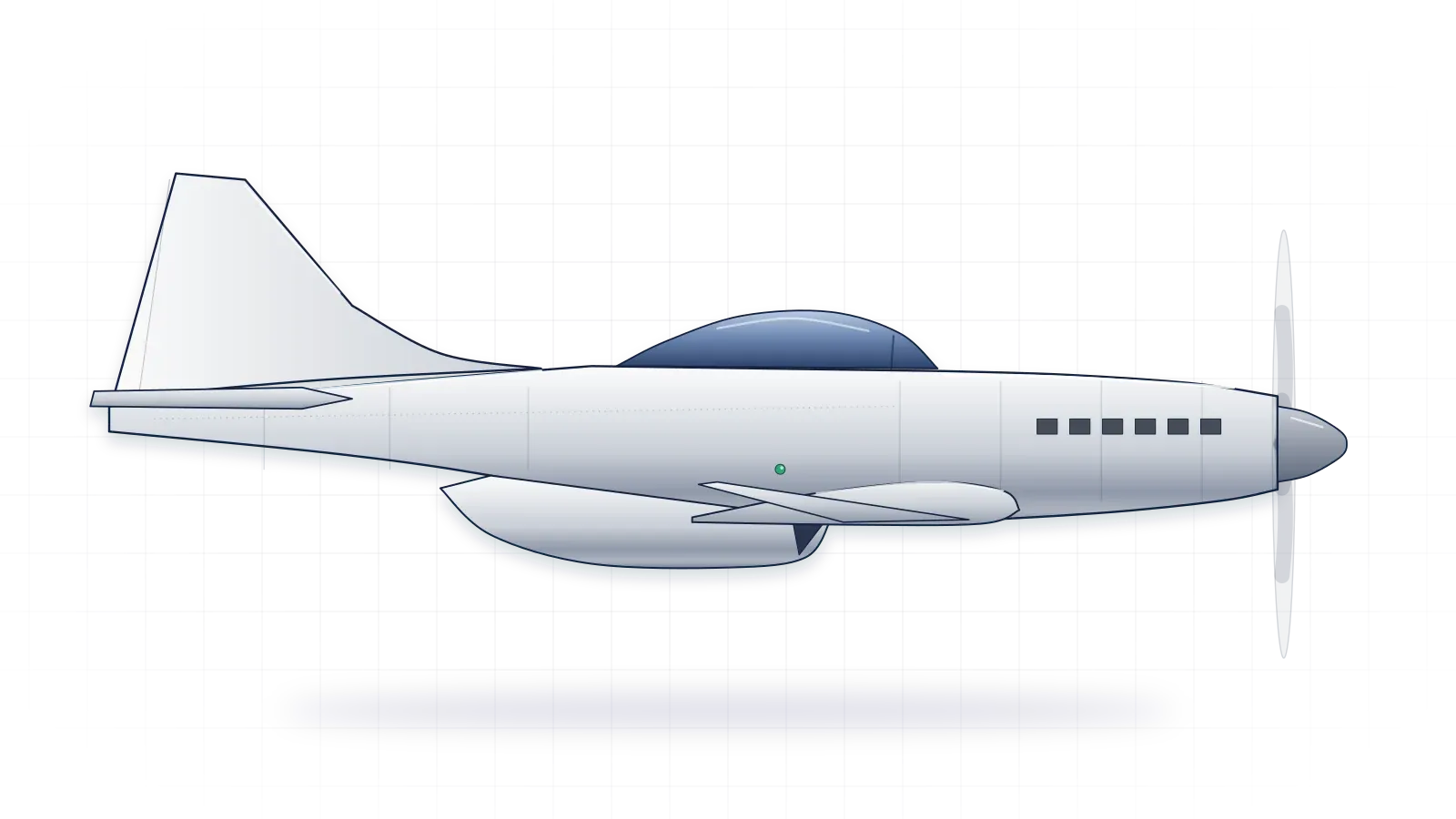
The P-51 Mustang was the first single-engine fighter based in Britain to reach Berlin. More than 14,000 were built, and 8,302 of them were D models, with a bubble canopy and six machine guns.
Updated
Role
Escort fighter
Power
One piston engine
First flight
October 26, 1940 (Boeing) or October 25, 1940 (Smithsonian), NA-73X prototype
Tier
Iconic
The North American P-51 Mustang was the long-range escort fighter of the Second World War's final two years, and it started as a rush job for someone else. In 1940, British purchasing agents asked North American Aviation to build Curtiss P-40s under license. The company offered an original design instead and promised it in under three months.
The first airframe, the NA-73, was finished 117 days later. Its first flight came in October 1940: Boeing's history, which now holds North American's records, gives October 26, while the Smithsonian gives October 25. The Royal Air Force ordered 150 and named it Mustang.
More than 14,000 were built. The definitive P-51D, with a cut-down rear fuselage, a bubble canopy and six .50-caliber machine guns, accounted for 8,302 of them, more than all other versions combined.
Quick facts
| Fact | Value | Source |
|---|---|---|
| First flight | October 26, 1940 (Boeing) or October 25, 1940 (Smithsonian), NA-73X prototype | 2 |
| Role | Long-range escort fighter | 1 |
| Engine | One Packard-built Rolls-Royce Merlin V-1650, 1,695 hp (P-51D) | 2 |
| Top speed | 425 mph (P-51D); 490 mph (P-51H) | 2 |
| Wingspan | 37 ft | 2 |
| Armament | Six .50-caliber machine guns (P-51D) | 1 |
| Number built | More than 14,000, including 8,302 P-51Ds | 1 |
| Status | Retired; the last US Air Force P-51s were withdrawn in 1957 | 1 |
Why the North American P-51 Mustang matters
Bombers flying deep into Europe needed fighters to protect them, and early escorts could not go the whole way. The Mustang's first engine, an Allison, lost power at altitude. Rolls-Royce and fighter pilots who had flown the airplane urged a switch to the Merlin, whose supercharger held sea-level power up to about 30,000 feet, and the Merlin-powered XP-51B was about 50 mph faster. Once P-51s could stay with the bombers for the entire mission, bomber losses dropped sharply.
The Mustang was the first single-engine fighter based in Britain to reach Berlin, and it escorted B-29s across the Pacific too. The Tuskegee Airmen, the first Black aviators allowed to fly for the US military, flew mostly P-51s with red-painted tails in the 332nd Fighter Group.
It also marks a handover. The Merlin came from the Spitfire; the Mustang's successor as the fastest thing in the sky was the jet-powered Me 262, about 120 mph faster at the same altitude. The US Air Force did not retire its last P-51s until 1957.
Notable facts
- The P-51D's Packard-built Merlin V-1650 produced 1,695 horsepower and gave a top speed of 425 mph; the late-war P-51H reached 490 mph.
- The wing spans 37 feet and the airplane is about 32 feet long; the Smithsonian's example weighs 7,635 pounds.
- One weak point was the cooling system: the Smithsonian notes that a single bullet through a radiator or coolant pipe was usually enough to bring a Mustang down.
- The Smithsonian's P-51D-30-NA, serial 44-74939, was delivered in July 1945, never saw combat and flew 211 hours before being set aside as a museum specimen.
- In 1941 Charles "Chief" Anderson, who trained Black pilots at the Tuskegee Institute, took First Lady Eleanor Roosevelt flying when she visited.
In Planeology
In the app, each lesson you pass parks an aircraft in your Hangar. The North American P-51 Mustang is Bay 33 of 56. Earn it by passing Mustang & the Escort Fighters, in the WWII in the Air lesson group.
Guides
Guides to read next
Aircraft
Nearby in the Hangar
Sources
- Smithsonian National Air and Space Museum, North American P-51D Mustang
- Boeing, Select Products in Boeing History
- Smithsonian National Air and Space Museum, Tuskegee Airmen
- Smithsonian National Air and Space Museum, Messerschmitt Me 262 A-1a Schwalbe (Swallow)