LEG 01 · How Flight Works
How Do Planes Fly? Lift, Thrust, Drag and Weight, Explained
A wing bends the air downward and the air pushes back. Everything else about flight follows from that one idea.
Updated · 7 min read
The short answer
Planes fly because their wings push air downward as they move forward, and the air pushes the wings up in return. That upward push is lift. Engines supply thrust to overcome drag, the air's resistance, so the wings keep moving fast enough to make lift. When lift balances weight and thrust balances drag, the airplane cruises steadily.
Ask a dozen people on a flight how the airplane stays up and you’ll hear a dozen answers, most of them involving the shape of the wing and a vague memory of a science class. The real answer is simpler than the folklore, and more satisfying. It comes down to four forces, one of which the wing makes for itself by bending the air.
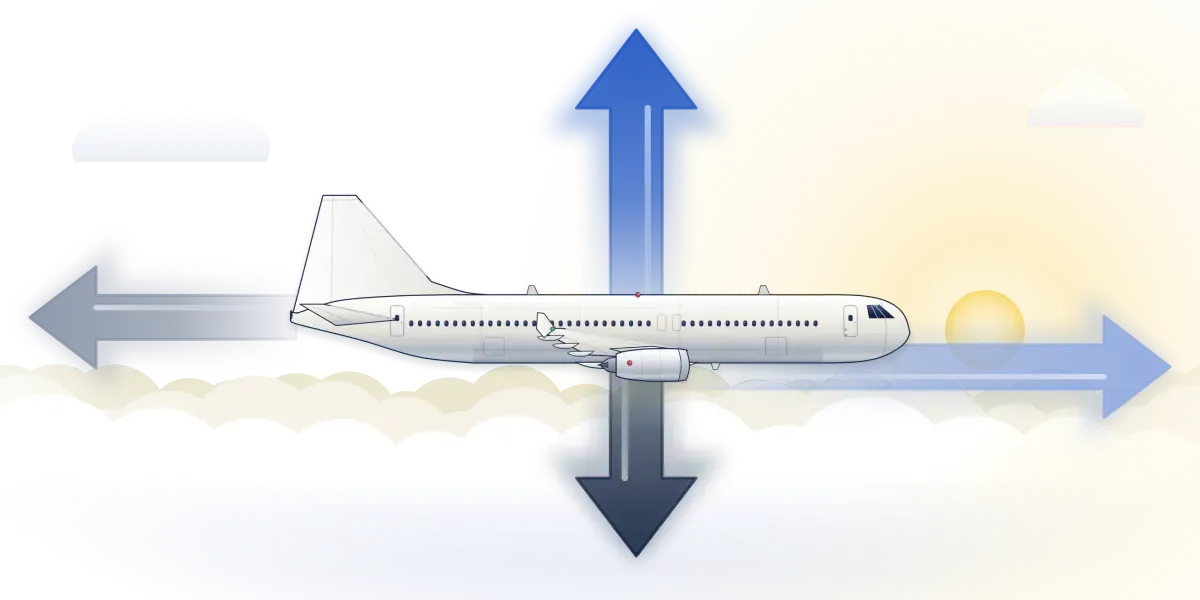
What are the four forces of flight?
Every airplane in the air is being pulled and pushed by four forces at once. Weight pulls it down. Lift pushes it up. Thrust drives it forward. Drag, the air’s resistance to anything moving through it, holds it back. Which way the airplane goes, and how fast, depends on how those four compare.
Weight is gravity acting on the airplane and everything in it: the structure, the fuel, the people and the bags. It always points toward the center of the Earth. Although it is spread through the whole machine, it behaves as if it were gathered at a single point, the center of gravity. And it keeps changing during a flight, because burning fuel makes the airplane lighter hour by hour.
The word “balance” trips people up. Balanced forces don’t mean the airplane stops. They mean it stops changing. In a steady, level cruise, lift equals weight and thrust equals drag, so the airplane holds the same speed and the same altitude. Let one force win, even slightly, and the airplane climbs, sinks, speeds up or slows down until a new balance is found.
How does a wing make lift?
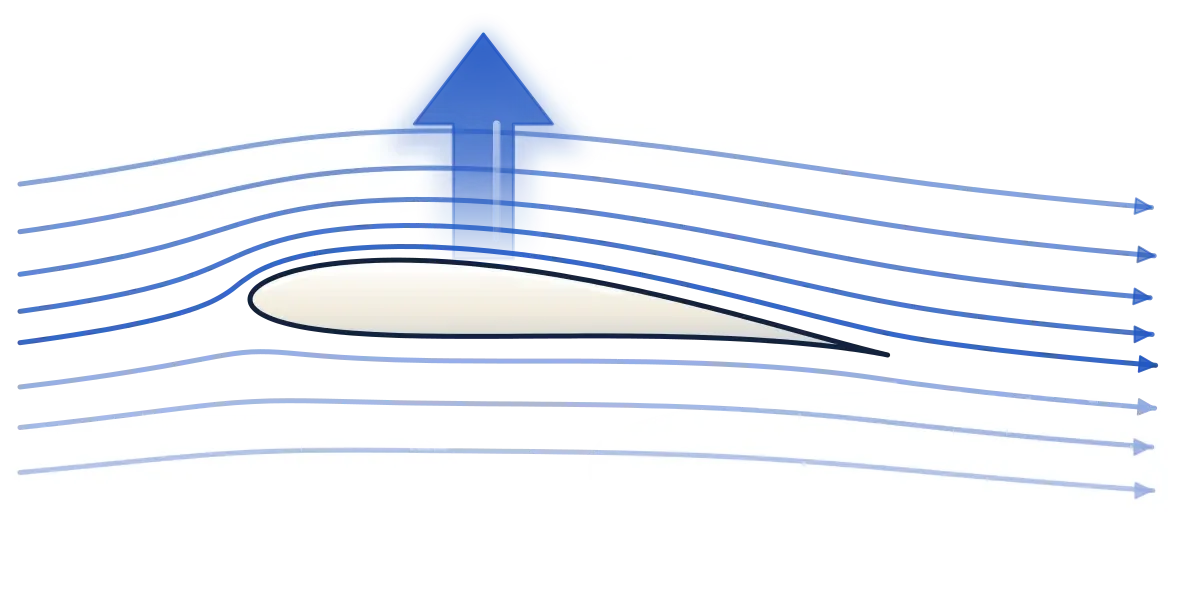
A wing is shaped and tilted so that it bends the air flowing past it downward. Push air down, and Newton’s third law says the air pushes back up on the wing with an equal and opposite force. That upward reaction is lift, and it holds up everything from a paper airplane to a jumbo jet.
The same event can be described in terms of pressure. Air speeds up as it flows over the curved upper surface of the wing, and faster-moving air has lower pressure. The higher pressure underneath pushes the wing toward the lower pressure above. This is the Bernoulli view, and it is just as correct as the Newton view, because it describes the same airflow from a different angle. NASA’s Beginner’s Guide to Aeronautics makes the point bluntly: the two names are labels for two camps in a long argument, and both camps are right.
Is the “longer path” explanation true?
No. The popular version says that air going over the longer, curved top surface must hurry to meet the air going underneath at the trailing edge, so it moves faster and its pressure drops. NASA calls this the “equal transit” theory, and it is wrong. Air over the top really does move faster, but far faster than the theory predicts, and it reaches the trailing edge first. It never rejoins the air it started beside.
The longer-path story also fails a simple test. A paper airplane with a flat wing flies perfectly well, and so does an aerobatic airplane flying upside down. Neither has a longer top surface to speak of. What they have is a wing meeting the air at an angle, and that angle is the key to the whole subject.
What is the angle of attack?
Slice a wing from front to back and you get its airfoil: a rounded leading edge, a curved upper surface and a thin trailing edge. Two terms describe the shape. The chord line is an imaginary straight line from the leading edge to the trailing edge. Camber is the curve of the upper and lower surfaces, and many wings are curved more on top than underneath, which helps them make lift.
The angle of attack is the angle between the chord line and the oncoming air. It is measured against the air, not against the horizon, so an airplane can have a high angle of attack with its nose pointing almost level. For modest angles, lift rises steadily as the angle grows. That is why a wing flying slowly has to meet the air at a steeper angle: it needs more lift from every bit of speed it has.
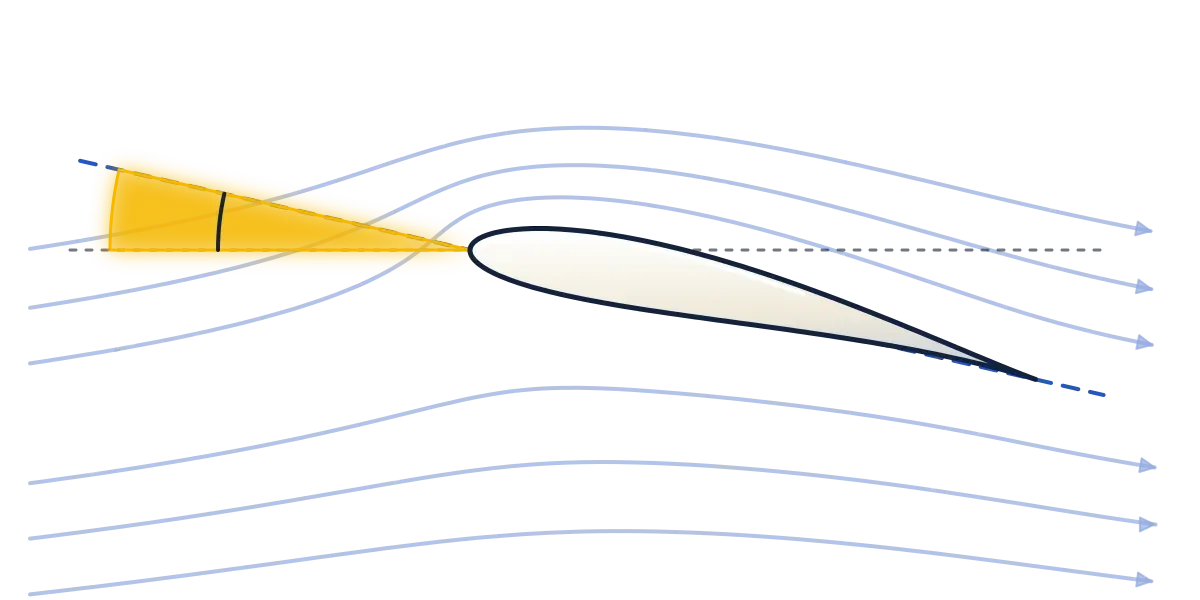
A symmetrical airfoil, curved equally on top and bottom, makes no lift at all at zero angle of attack. Tilt it and lift appears. That is how an airshow pilot flies inverted: the wing is held at an angle that turns the air downward, whichever way up the airplane happens to be. Propeller blades and tail surfaces are airfoils too, each shaped to turn moving air into a useful force.
Why do planes need to go so fast to take off?
Because lift grows with the square of speed. Double the speed and the same wing, at the same angle, can make four times as much lift. That relationship is built into the lift equation that NASA uses in its beginner’s guide: lift depends on the wing’s area, its shape and angle, the density of the air, and the speed squared.
For a heavy airliner, the consequence is a long takeoff run. The wing only makes enough lift to match the airplane’s weight once it is moving quickly, and getting a few hundred tonnes up to that speed takes a lot of runway. Once airborne, the pilots can climb away at a lower angle of attack as the speed builds.
Air density matters as well. Hot air is thinner than cold air, and the air at a high-altitude airport is thinner than at sea level. In both cases the wing needs more speed, and therefore a longer run, to make the same lift, and the engines make less thrust in thin air too. The FAA’s handbook describes this effect as a higher “density altitude”, and it is why summer afternoons at a mountain airport are the hardest conditions for any wing.
What do the engines actually do?
Not what most people assume. An engine’s job is to beat drag, not to hold the airplane up. NASA gives a memorable example: an airliner weighing a million pounds might cruise on four engines making a grand total of about 200,000 pounds of thrust. That is a fifth of the airplane’s weight. The engines could never lift it. They only have to keep it moving fast enough through the air for the wings to do the lifting.
That is also why a glider, with no engine at all, can stay aloft for hours. As it slowly descends, its forward motion through the air keeps its wings making lift. A tow plane or a winch gives it speed and height; after that, gravity provides the “thrust” in exchange for a gentle sink rate, and rising air can pay the altitude back.
Why do many wingtips curve upward?
Those upturned tips are winglets, and they exist because lift has a side effect. The higher-pressure air under a wing spills around the tip toward the lower-pressure air above, and spins off behind each wingtip as a swirling vortex. Those vortices create a drag of their own, called induced drag, that the airplane pays for in fuel.
In the 1970s, NASA engineer Richard Whitcomb proposed a small, nearly vertical surface at the tip to weaken the vortex, and predicted it could cut induced drag by about 20 percent on a transport-sized airplane. NASA, the US Air Force and Boeing then flew nine-foot-tall winglets on a KC-135 tanker at NASA’s Dryden center in 1979 and 1980. The tests showed a 7 percent improvement in lift-to-drag ratio and the 20 percent cut in induced drag that Whitcomb had predicted. Boeing introduced winglets on the 747-400 in 1989, and NASA says the blended winglets now fitted to thousands of airliners save between 4 and 6 percent of their fuel.
So the next time you sit over the wing, that graceful curve at the end of it is doing a quiet, measurable job: it is trimming the drag that the wing’s own lift creates.
What happens when a wing stops working?
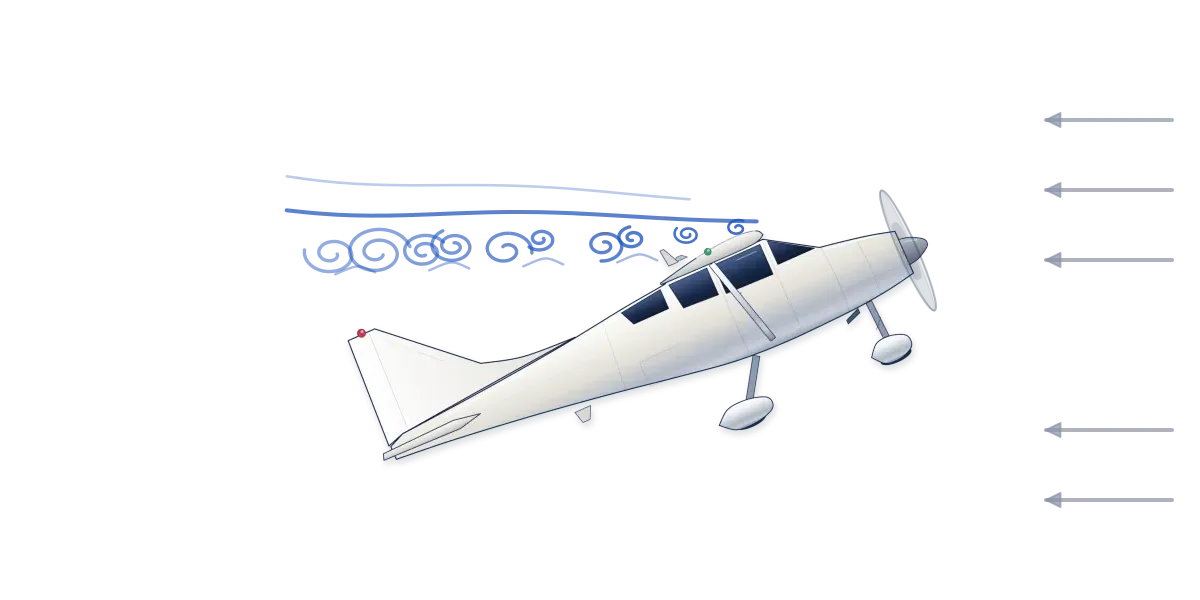
The same angle of attack that creates lift can also take it away. Every wing has a critical angle, roughly 16 to 20 degrees depending on the design. Below it, tilting the wing further makes more lift. Beyond it, the smooth flow over the top surface can no longer follow the curve and breaks away, and lift falls off sharply. That is a stall, and it has nothing to do with the engine. Airplanes carry warning systems that sound well before the critical angle is reached, and the full story is in What is a stall?
What to watch for on your next flight
A window seat over the wing turns this whole article into a live demonstration.
- On the takeoff roll, notice how long the airplane runs before the nose lifts. That is the wing waiting for enough speed, because lift grows with speed squared.
- Just after takeoff, the nose stays high while the airplane is slow. That is the angle of attack doing its work until speed builds and the nose can come down.
- In cruise, the wing sits at a shallow angle and the engines sound relaxed. Lift is matching weight, and thrust only has to match drag.
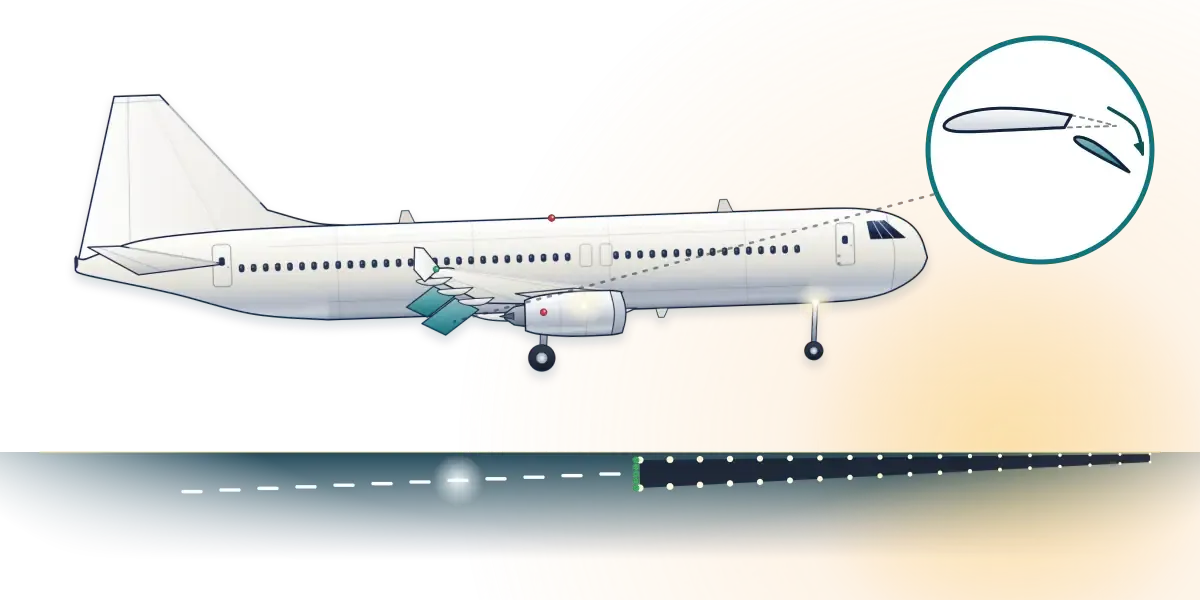
- Before landing, watch the flaps and slats slide out to reshape the wing, so it can make enough lift at a much lower speed.
- At the wingtip, look for the winglet, and remember that it is there to tame the vortex that lift leaves behind.
Lift, weight, thrust and drag. Four forces, and a wing that makes one of them by bending the air. Everything else in aviation, from the height airliners cruise at to the shape of a fighter, is a variation on that theme.
Quiz
Check yourself
-
Question 1 of 3
A wing pushes the passing air downward. What does the air do to the wing?
- Pushes it downward
- Has no effect on it
- Pushes it upward
- Twists it sideways
Show the answer
Answer: C. By Newton's third law, pushing air down produces an equal and opposite push up on the wing: lift.
-
Question 2 of 3
What is the main job of an airliner's engines?
- Keeping it level in gusts
- Holding up its weight
- Overcoming drag
- Steering it through turns
Show the answer
Answer: C. Engine thrust overcomes drag; it's the wings that make the lift to hold up the airplane's weight.
-
Question 3 of 3
If a wing flies twice as fast, about how much more lift can it make?
- Eight times as much
- Four times as much
- Exactly the same
- Twice as much
Show the answer
Answer: B. Lift grows with the square of speed, so doubling the speed gives about four times the lift.
Guides
Keep reading
Navigation & Weather
Why Do Planes Fly at 35,000 Feet? Thin Air, Smooth Rides and Saved Fuel
How Flight Works
What Is a Stall in an Aircraft? (It's Not the Engine)
Anatomy of an Airplane
What Are Those Moving Parts on the Wing? Flaps, Slats and Spoilers
Engines & Propulsion
How Do Jet Engines Work? Turbojets, Turbofans and Turboprops
Aircraft
From the Hangar
Sources
- NASA Glenn Research Center, Four Forces on an Airplane
- NASA Glenn Research Center, Bernoulli and Newton
- NASA Glenn Research Center, Equal Transit Theory
- NASA Glenn Research Center, Lift Equation
- NASA Glenn Research Center, Effects of Inclination on Lift
- Federal Aviation Administration, Pilot's Handbook of Aeronautical Knowledge (FAA-H-8083-25C)
- NASA Spinoff, Winglets Save Billions of Dollars in Fuel Costs