BAY 26 Rare
1903 Wright Flyer: Twelve Seconds That Started It All
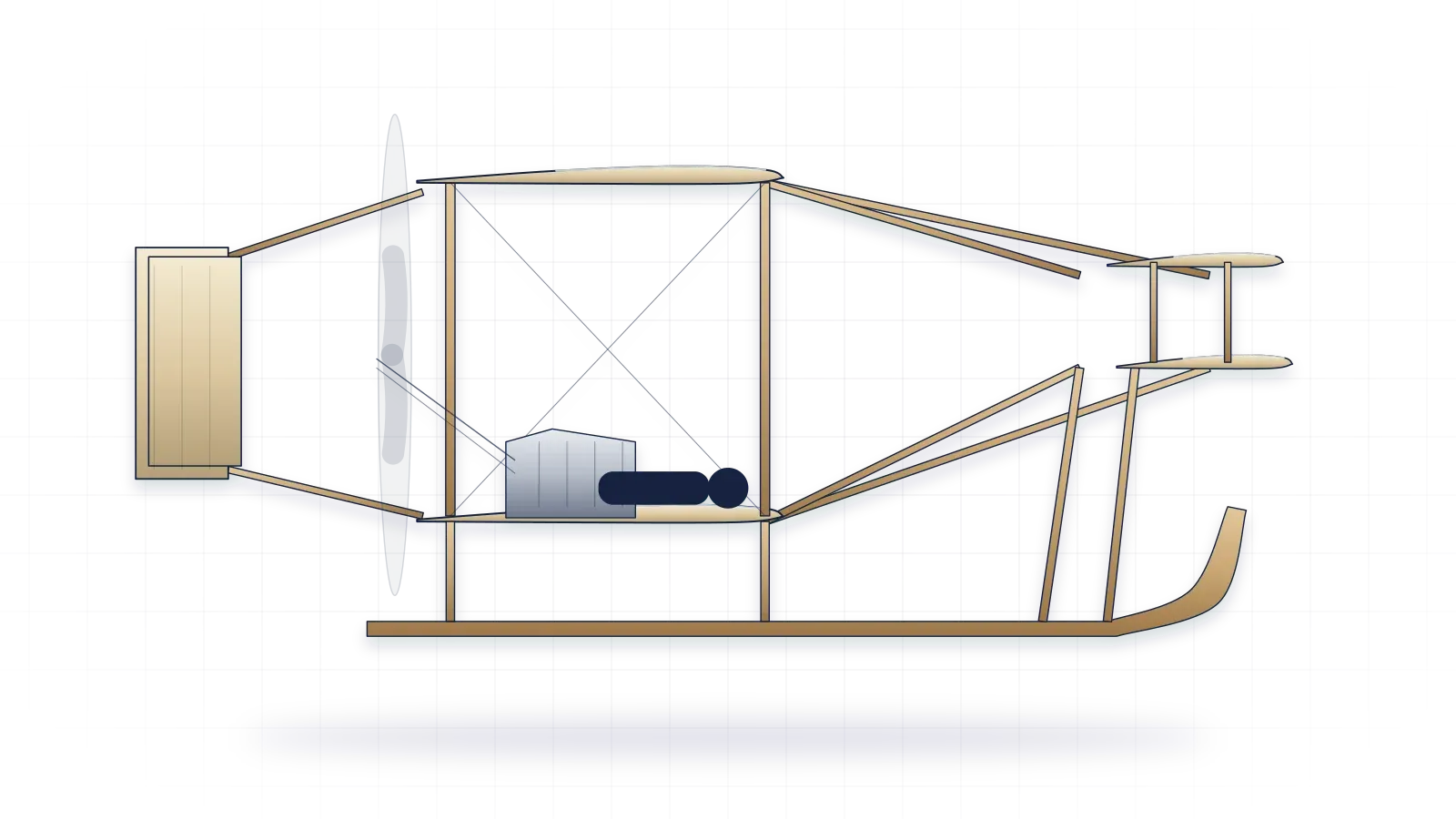
At Kitty Hawk on December 17, 1903, the Wright Flyer made the world's first successful flights of a powered, heavier-than-air flying machine. Its 12-horsepower engine drove two propellers that the brothers designed as rotating wings.
Updated
Role
Experimental airplane
Power
One piston engine
First flight
December 17, 1903, Kitty Hawk, North Carolina
Tier
Rare
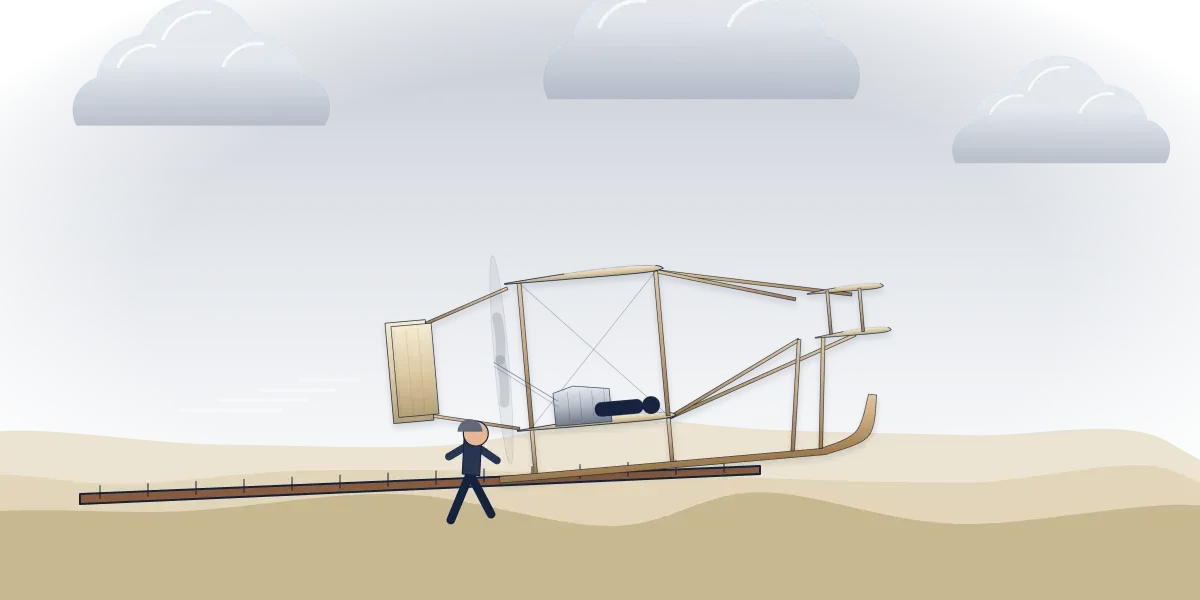
The 1903 Wright Flyer is the airplane that worked. On December 17, 1903, at Kitty Hawk, North Carolina, Wilbur and Orville Wright made the world's first successful flights of a powered, heavier-than-air flying machine. They made four that morning, taking turns at the controls.
It is a canard biplane, meaning the elevator sits out in front, with two pusher propellers behind the wings. One 12-horsepower, four-cylinder engine, built with the brothers' mechanic Charlie Taylor, turns both propellers through chains and sprockets. The frame is wood and the covering is muslin, left with no sealant or paint.
Orville flew first, for 12 seconds and 120 feet (36 m). Wilbur flew the fourth and longest, 852 feet (255.6 m) in 59 seconds. While the group talked over that last flight, a gust flipped the Flyer and rolled it across the sand, damaging it so badly that it never flew again.
Quick facts
| Fact | Value | Source |
|---|---|---|
| First flight | December 17, 1903, Kitty Hawk, North Carolina | 1 |
| Role | Experimental airplane; the first successful powered airplane | 1 |
| Engine | One 12-hp Wright four-cylinder, driving two pusher propellers | 1 |
| Wingspan | 12.3 m (40 ft 4 in) | 1 |
| Weight | 274 kg (605 lb) empty; 341 kg (750 lb) gross | 1 |
| Crew | One pilot | 1 |
| Longest flight that day | 852 ft (255.6 m) in 59 seconds | 1 |
| Number built | One; damaged after the fourth flight and never flown again | 1 |
Why the 1903 Wright Flyer matters
The Wrights' great insight was control. They warped, or twisted, the wingtips to roll, a job ailerons do on airplanes today. Their 1902 glider added a movable rudder, which made it the first aircraft with control in all three axes. By the Smithsonian's count they made between 700 and 1,000 glides in it that year, so by 1903 they already knew how to steer.
They did their own research, too. Their 1901 glider made only about a third of the lift that published figures predicted, so they began to doubt the figures. In the back room of their Dayton bicycle shop they built a wind tunnel and tested more than fifty wing shapes. They even shaped the propellers as rotating wings, an idea the Smithsonian ranks among their most inventive.
In the Smithsonian's description, the powered airplane was the 1902 glider made bigger and stronger, with propulsion as its one truly new ingredient. Improved Flyers followed in 1904 and 1905, and on October 5, 1905, Wilbur stayed up for 39 minutes and covered 24.5 miles (39.2 km) around a closed course. The Wright brothers guide tells the whole story, and how planes fly explains the lift they were after.
Notable facts
- Wilbur won a coin toss to go first, but his attempt on December 14 failed and slightly damaged the Flyer. After repairs, Orville lifted off at 10:35 a.m. on December 17.
- The brothers found Kitty Hawk by asking the U.S. Weather Bureau for a test site. It had brisk, steady winds and soft sand to land on.
- Crated in a shed behind the bicycle shop, the Flyer spent eleven days under water and mud in the Dayton flood of March 1913.
- From 1928 the Flyer was on loan to the Science Museum in London. During World War II it sheltered underground near Corsham, about 100 miles from the city, not in the London Underground, despite a story often told.
- Orville Wright's last flight came decades after Kitty Hawk, as copilot on a test run of the Lockheed Constellation airliner at Wright Field, Ohio.
Where to see one
The original Flyer is the heart of The Wright Brothers & The Invention of the Aerial Age, Gallery 107 on the first floor of the National Air and Space Museum in Washington, DC. It has been on public display at the Smithsonian since its donation on December 17, 1948, the 45th anniversary of the flights. 4
In Planeology
In the app, each lesson you pass parks an aircraft in your Hangar. The 1903 Wright Flyer is Bay 26 of 56. Earn it by passing The Wright Brothers, in the Pioneers of Flight lesson group.
Guides
Guides to read next
Aircraft
Nearby in the Hangar
Sources
- Smithsonian National Air and Space Museum, 1903 Wright Flyer
- National Park Service, Wright Brothers
- Lockheed Martin, How the Constellation Became the Star of the Skies
- Smithsonian National Air and Space Museum, The Wright Brothers & The Invention of the Aerial Age