LEG 06 · Navigation & Weather
What Are Contrails? Why Planes Leave White Trails
Those white lines are clouds made of ice. Whether they vanish in seconds or spread across the sky depends on the air miles above your head.
Updated · 7 min read
The short answer
Planes leave white trails because jet exhaust is hot and rich in water vapor. At cruising height the air is so cold that the vapor condenses onto tiny particles and freezes into ice crystals, forming a line-shaped cloud called a contrail. In dry air it vanishes within seconds or minutes; in humid air it can last for hours.
Look up on a clear day near a busy air route and the sky is often scored with white lines. Some fade almost as soon as they appear. Others stretch from horizon to horizon and slowly widen into a thin haze. They are clouds made by airplanes, and the way they behave says a lot about the air miles above the ground.
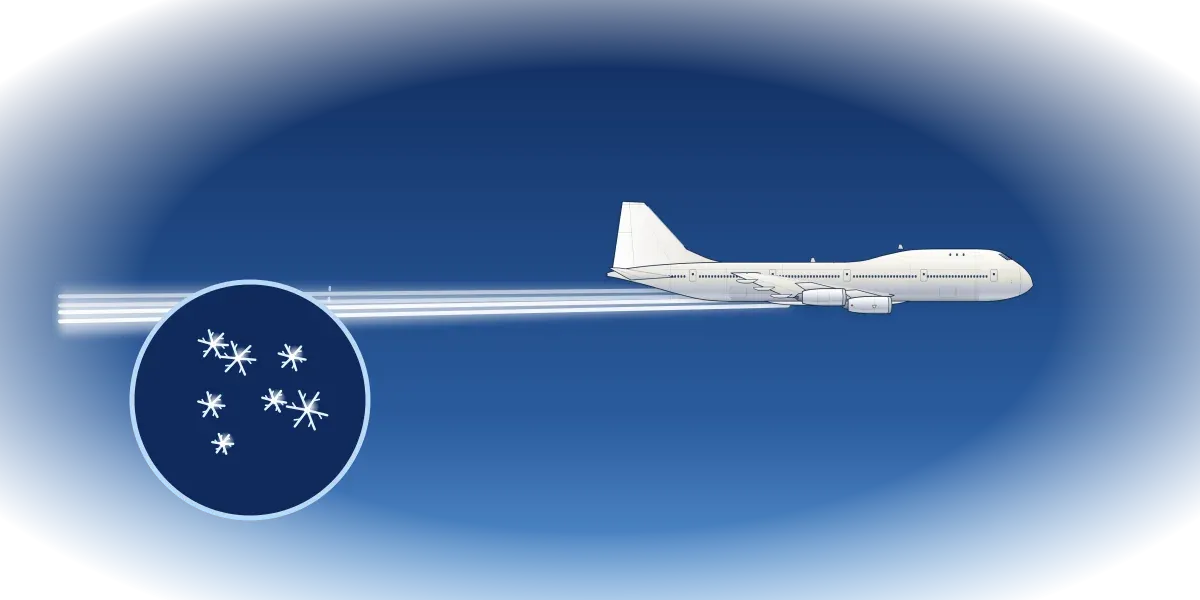
Why do planes leave trails in the sky?
The white trail behind a jet is a contrail, short for condensation trail. Burning jet fuel produces water vapor along with carbon dioxide, and how jet engines work covers the machine that does the burning. The FAA breaks down what comes out of the combustion: 71 percent carbon dioxide, 28 percent water vapor and less than 1 percent everything else, including soot and sulfur compounds.
Up at cruising height the outside air is bitterly cold, as cold as −70 °F according to the FAA’s contrails fact sheet. When the hot, moist exhaust mixes with it, the mixture cools fast. If it reaches saturation, the water vapor condenses onto tiny particles, some from the engine and some already floating in the air. The droplets freeze almost at once, and a line of ice crystals appears behind the airplane.
The FAA compares it to seeing your breath on a cold day. NASA’s contrail chart draws the same process as a graph of temperature against moisture. The exhaust starts out hot and moist, and the surrounding air is cold and fairly dry. A contrail forms only if the mix passes through the zone where water condenses on its way from one to the other.
What are contrails made of?
Mostly ice. It is tempting to think of contrails as smoke. NASA Earthdata stresses that they are made mostly of ice crystals, and the FAA’s fact sheet agrees that they are mainly frozen water. Water vapor itself is invisible; what you see is the ice.
Strictly, the engine only has to supply the water. The FAA notes that fine particles are found all through the atmosphere, so there is always something for the vapor to condense on. In humid air, the new crystals then keep growing by taking water from the air around them. That is how a long-lived contrail ends up far bigger than the exhaust that seeded it.
Exhaust chemistry still plays a part. The FAA notes that sulfur oxides and unburned hydrocarbons can slow the melting of the ice crystals, helping some contrails last longer.
Why do some planes leave contrails and others don’t?
It comes down to the air at the airplane’s height. The FAA says contrails will not form if that air is too warm or too dry, and the humidity up there can be very different from what people feel on the ground. One jet can cross a dry layer and leave nothing, while another, a few thousand feet higher or lower, meets moist air and draws a long white line.
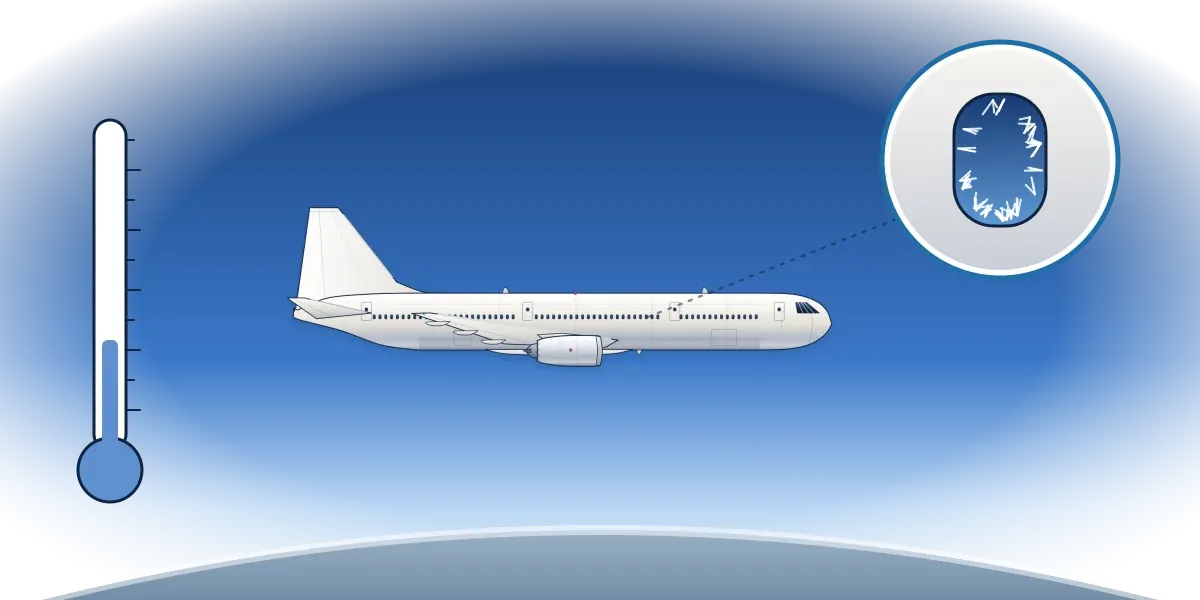
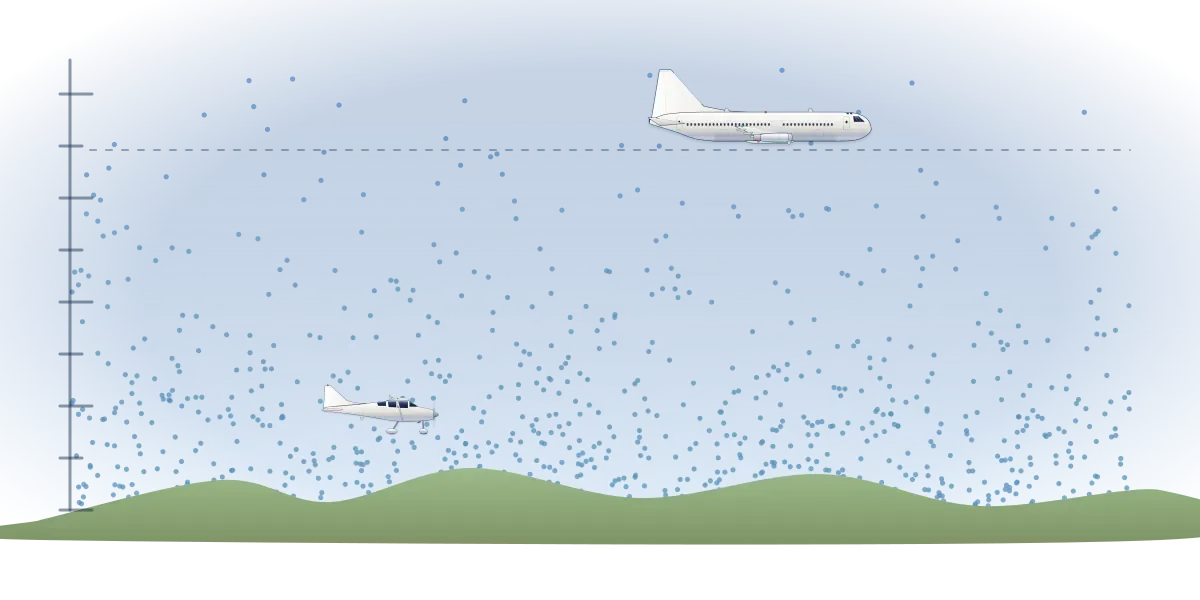
Height matters because of the cold. In the lower atmosphere the temperature drops about 2 °C for every 1,000 feet of climb, and NASA Earthdata notes that most commercial jets cruise at 26,000 feet or higher. Up there the vapor freezes at once. Lower-flying aircraft don’t make contrails, because the air around them is too warm.
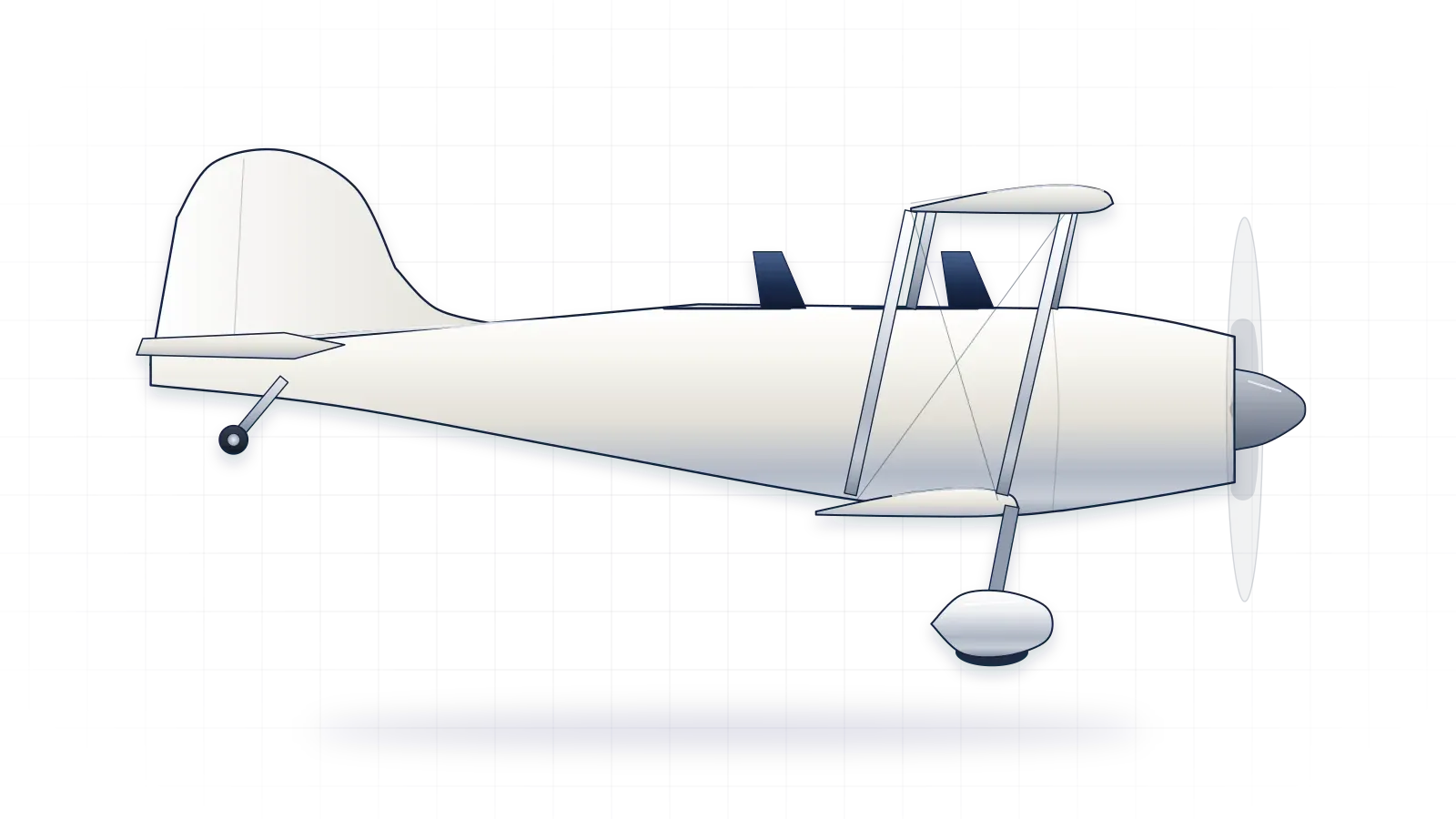
A NASA classroom guide puts small airplanes, such as a Cessna 172 Skyhawk, at roughly 2,500 to 9,500 feet, far too low. The white streams behind aerobatic airplanes at an air show, such as a Pitts Special looping overhead, aren’t contrails either. NASA Earthdata explains that the trails left by low-flying display planes are special effects, made with smoke.
Sometimes a contrail seems to switch on and off in mid-sky. The FAA explains that the airplane is flying in and out of pockets of very humid air, called ice supersaturation regions. Nothing about the engine has changed; the air has.
Why do some contrails stay in the sky so long?
Because the air they form in is humid enough to keep the ice. NASA’s contrail chart and the FAA’s fact sheet sort contrails into three kinds:
- Short-lived contrails form in dry air. The ice turns straight back into vapor as the exhaust mixes away. The trail vanishes within seconds or minutes, so it stays a roughly constant length behind the airplane.
- Persistent contrails form in very humid air and stay in the sky after the airplane has gone. Where there is little wind shear, a change in wind speed or direction over a short distance, they can hold a thin line for hours. The FAA says some last more than a day.
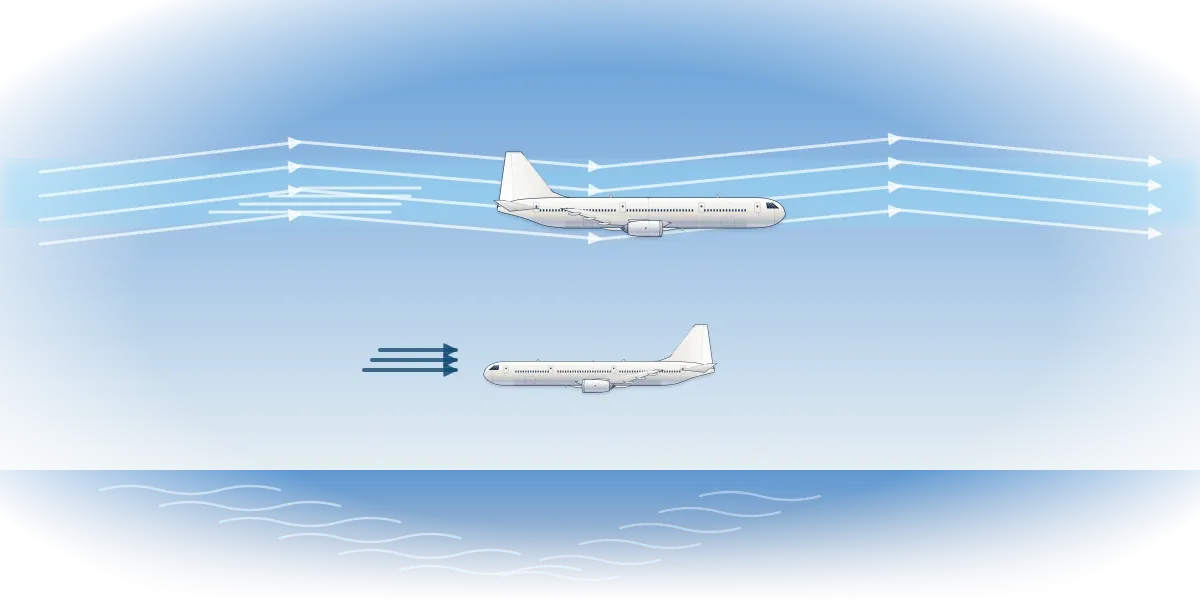
- Persistent spreading contrails need very humid air too, but form where the wind shears, the same uneven air described in is turbulence dangerous? Their ice keeps growing while the wind smears them sideways, until they look like natural cirrus cloud.
NASA’s chart offers a neat test. Hold a finger up at arm’s length: a persistent contrail is usually thinner than the finger, while a spreading one is wider. Once it has spread far enough, a contrail is hard to tell apart from natural cirrus, the FAA says, and some natural cirrus gets mistaken for old contrails.
Satellites watch them too, once they grow wide enough. In the satellite images a NASA team used, a contrail only shows up once it is about a kilometer wide, the size of one pixel.
The fastest of those upper winds are the jet streams, rivers of air that NOAA says can reach 250 mph or more. They are also the reason flying east is often faster than flying west.
Are contrails bad for the environment?
On balance they appear to add to warming, though scientists are still measuring how much. Like any high cloud, a contrail does two things at once. It reflects some sunlight back to space, which cools, and it traps some of the heat rising from the Earth, which warms. NASA Earthdata has described a study that used satellite data to weigh the two.
Working from 2006 measurements by the MODIS instrument on NASA’s Aqua satellite, the researchers found that line-shaped contrails warm more than they cool, acting as a light blanket. Globally the effect was small. One of the scientists said it would have to grow roughly 100 times to match the warming from all the carbon dioxide people have added to the atmosphere.
Regionally it was larger. The strongest warming showed up along the busy North Atlantic flight corridors, with another hot spot over central Europe. Because the team counted only line-shaped contrails, they called their figure a low estimate and suspected the full effect was at least three times bigger.
Other sources point the same way. The FAA’s fact sheet cites estimates that cloud cover in some flight corridors has risen by as much as 20 percent. NASA’s chart calls persistent contrails a human-made increase in Earth’s cloudiness that is likely to be affecting climate.
That has made them a research target. The FAA lists better forecasts of the humid layers where persistent contrails form, routing flights around those layers, new engine technology and new fuels among the ideas under study.
Are contrails harmful to humans?
Not directly. The FAA’s fact sheet says contrails are made mainly of ice and pose no direct health risk to people. It also says long-lasting trails are not a sign that an airplane has dispersed harmful chemicals, and that the US government is not modifying the weather or releasing harmful agents into the atmosphere.
Jet fuel contains no metal-based compounds, the fact sheet adds, because dissolved metals would upset how engines run. Exhaust pollution near the ground is a separate matter, which the FAA says it studies with the EPA and other agencies.
What to watch for next time you look up
- The length of the trail. A short trail that keeps a fixed distance behind the airplane means dry air at that height. A line that stays put long after the airplane has gone means humid air up there.
- The finger test. Hold a finger at arm’s length. A trail thinner than the finger is a persistent contrail; a wider one is spreading toward cirrus.
- Gaps in the line. A trail that starts and stops marks an airplane crossing pockets of humid air.
- Separate lines that merge. A four-engine jet such as the Boeing 747 can draw a trail from each engine before they blend into one.
- Color at sunrise and sunset. The FAA notes that contrails can look gray, red, orange or yellow as the sun moves, because their ice reflects its light.
- Spirals from the wingtips. In very humid air, NASA Earthdata notes, some aircraft trail swirls of cloud from each wingtip.
A contrail is weather you can watch being made. The cold that freezes it comes with the thin air airliners seek out, as why do planes fly so high? explains. The winds that carry it away are the same ones that make flying east faster.
Quiz
Check yourself
-
Question 1 of 3
What are contrails made of?
- Smoke from the engines
- Unburned fuel
- Dust from the air
- Ice crystals
Show the answer
Answer: D. Water vapor in engine exhaust condenses around tiny particles and freezes into ice crystals in the cold air.
-
Question 2 of 3
About how much does temperature fall for every 1,000 feet of climb in the lower atmosphere?
- About 2 °C
- About 0.1 °C
- About 10 °C
- About 25 °C
Show the answer
Answer: A. In the troposphere, temperature drops by about 2 degrees Celsius for every 1,000 feet gained.
-
Question 3 of 3
Which way do jet streams generally blow?
- North to south
- West to east
- East to west
- South to north
Show the answer
Answer: B. Jet streams generally blow from west to east, though their paths bend north and south.
Guides
Keep reading
Navigation & Weather
Why Do Planes Fly at 35,000 Feet? Thin Air, Smooth Rides and Saved Fuel
Navigation & Weather
Why Is Flying East Faster Than Flying West?
Navigation & Weather
Is Turbulence Dangerous? What's Happening When the Plane Shakes
Engines & Propulsion
How Do Jet Engines Work? Turbojets, Turbofans and Turboprops
Aircraft
From the Hangar
Sources
- NASA Langley Research Center, Contrail Identification Chart and Formation Guide
- NASA Earthdata, On the Trail of Contrails
- Federal Aviation Administration, Contrails
- Federal Aviation Administration, Contrails Fact Sheet
- Federal Aviation Administration, Pilot's Handbook of Aeronautical Knowledge (FAA-H-8083-25C)
- NASA, Where in the Air Classroom Activity Educator Guide
- NOAA Satellite and Information Service, What Is the Jet Stream?
- Smithsonian National Air and Space Museum, Pitts S-1C Special
- Boeing, Select Products in Boeing History