LEG 06 · Navigation & Weather
Is Turbulence Dangerous? What's Happening When the Plane Shakes
Turbulence is uneven air, not a failing airplane. Here is where the bumps come from, how much a wing can take, and what the records actually show.
Updated · 8 min read
The short answer
Turbulence is uneven air: rising currents, wind tumbling over mountains, storm clouds and sudden changes in wind called wind shear. Airliners are built to carry more than turbulence delivers, with structures proven to 150 percent of the highest loads expected in service. The real risk is to anyone up and unbelted when a jolt arrives, so the sign matters.
The coffee ripples, the overhead bins creak and the cabin drops just enough to lift your stomach. Nothing about the airplane has changed. What has changed is the air it is flying through, and the airplane was built for exactly this. Here is what turbulence is, what an airliner is designed to take, and what the official injury records say about where the real risk lies.
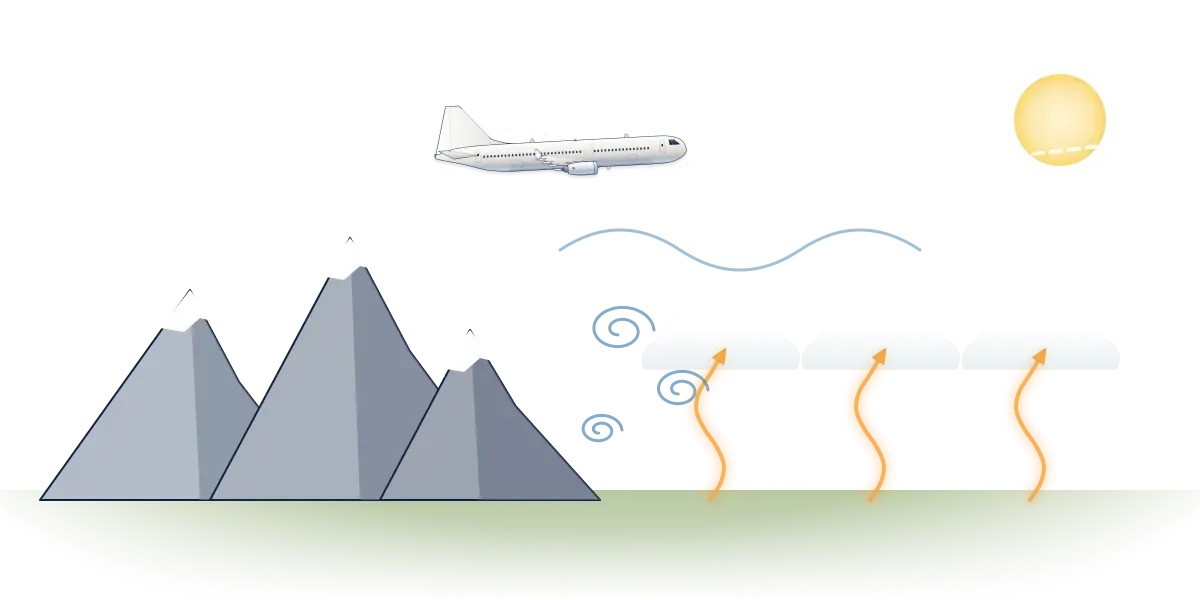
What causes turbulence?
Turbulence is uneven air. On a sunny afternoon the ground heats unevenly, and columns of warm air rise from fields, parking lots and towns like bubbles in a pot. An airplane crossing those columns at low altitude gets a lift, then a sag, then a lift again. Wind flowing over mountains, hills and even large buildings tumbles into eddies on the downwind side, the way water churns behind a rock in a stream.
Clouds matter too. A towering cumulus is a column of air rising fast, with rough, unstable air inside and around it. Wind shear can strike at any altitude. It is a sudden change in wind speed or direction over a short distance, and it shakes an airplane as it crosses from one stream of air into another.
High up, the main source is the jet stream. Jet streams are narrow bands of fast wind about 5 to 9 miles above the ground. They blow from west to east at around 110 mph on average, and sometimes at 250 mph or more. Their cores are smooth; their edges, where fast air rubs against slower air, are not. That edge is where most of the bumps at cruise altitude come from, and it is also the tailwind that makes flying east faster than flying west.
Some airplanes seek out rough air on purpose. NOAA’s two WP-3D Orion hurricane hunters fly through a hurricane’s eyewall and into its calm eye. On missions of 8 to 10 hours they drop probes that radio back pressure, humidity, temperature and wind.
What is clear air turbulence?
Clear air turbulence, or CAT, is turbulence met in cloudless sky, usually at high altitude and usually tied to wind shear. The FAA’s advisory circular on the subject puts it near jet streams, near the tropopause (the lid on the weather that airliners cruise close to) and along upper-air fronts. It is most often found on the poleward side of a jet stream, and more often above and downwind of mountain ranges, where the jet’s wind shear is sharpest.
The circular makes a point that surprises people: it is not the wind’s speed that shakes an airplane, but the change in speed from one place to the next. A jet stream core of 110 knots or more is the usual threshold for trouble, and the faster the wind drops off away from the core, the likelier the bumps. A typical patch of CAT is a long, thin slab stretched out along the wind, far wider than it is deep.
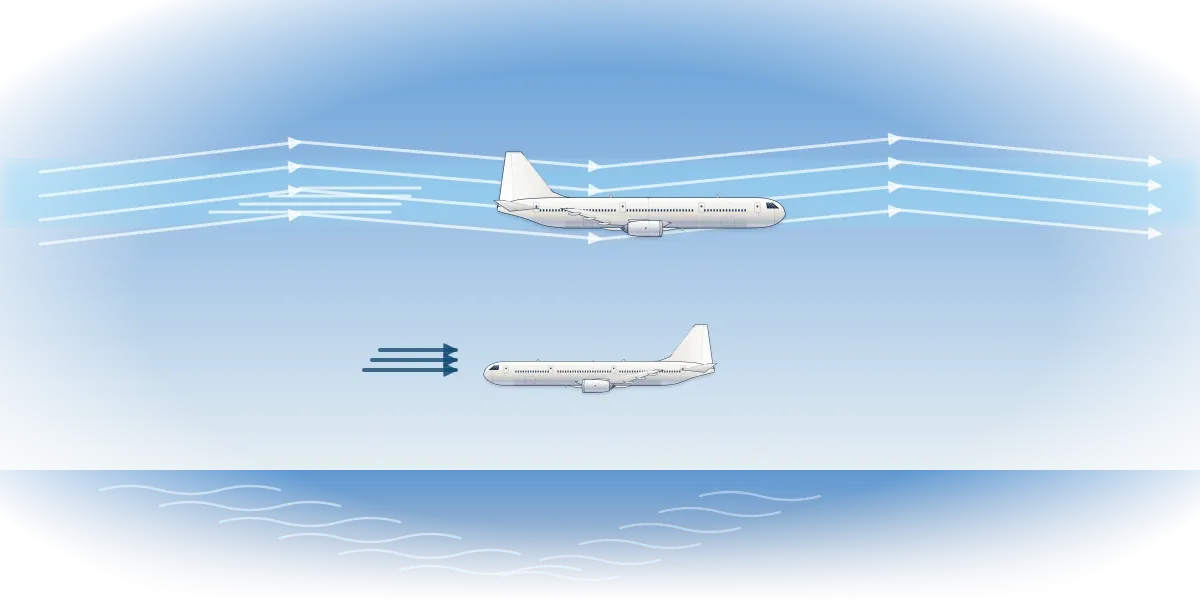
What makes CAT different from a storm is that there is nothing to see. No cloud marks it, and the weather radar in the nose is built to show precipitation, of which clear air has none. That is why the seat-belt sign can come on under a cloudless sky, and why pilots lean on reports from aircraft ahead of them. The height airliners cruise at, and the tropopause they cruise beneath, are explained in Why do planes fly at 35,000 feet?
How much turbulence can a plane handle?
Far more than it ever meets. Aircraft designers start from the highest loads expected in service, called limit loads, and the structure has to carry them without damage. The FAA’s handbook then explains the second step: the rules require the structure to support one and a half times those limit loads without failing. That multiplier is the factor of safety, and parts of the airplane may bend or twist under such loads, but they must hold. A NASA history of the rule traces the 1.5 figure to March 1934, when the US Army Air Corps made it a formal design requirement. It has anchored aircraft design ever since.
Manufacturers prove it with the real thing. In 1995, Boeing loaded a complete 777 airframe to ultimate load in a static test. Boeing defines that as 150 percent of the highest loads any airplane would meet in service. A separate fatigue test ran from 1995 to 1997, with 100 hydraulic actuators pushing and pulling on the airframe. It applied 120,000 cycles of taxiing, maneuvers, gusts and cabin pressurization: three design lifetimes.
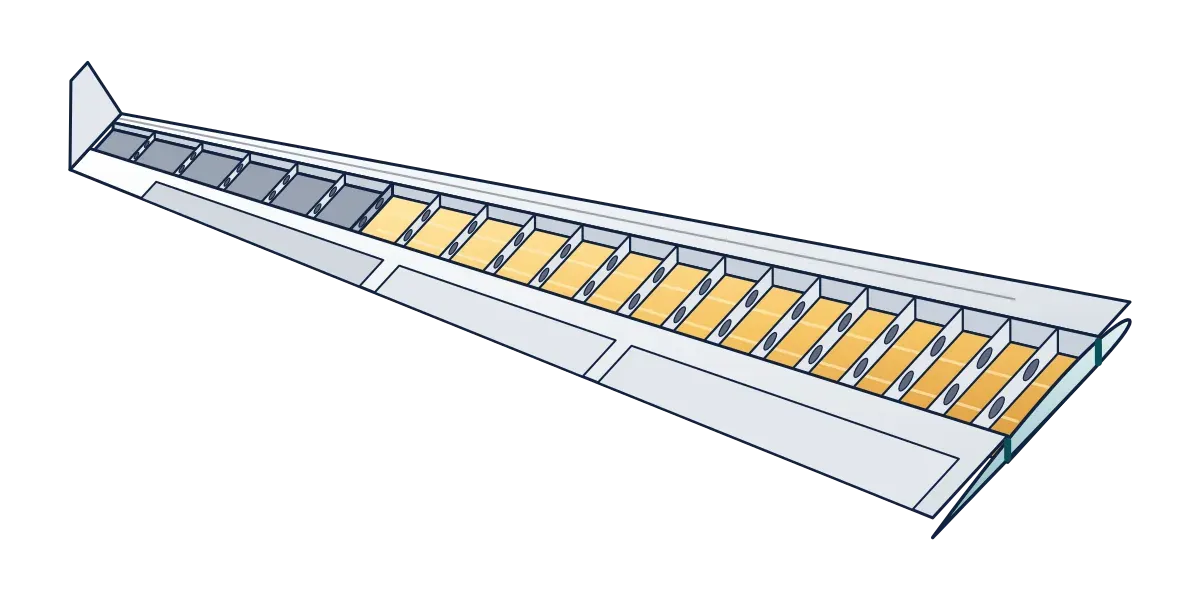
So a wing that flexes in rough air is doing its job. Spars run from root to tip and ribs set the shape, and the whole beam is built to bend and spring back. A gust changes the wing’s angle to the oncoming air for a moment. That changes its lift for a moment, and the change is what you feel as a bump. Why that angle matters so much is the subject of What is a stall?. A bump is nowhere near that territory. Crews also have a designated rough-air speed, slower than normal cruise, which eases the loads from each gust.
The NTSB’s ten-year review of turbulence on US airlines found the same thing from the other end: most turbulence accidents caused injuries to people, not damage to the airplane.
What do pilots mean by light, moderate and severe turbulence?
The FAA’s Aeronautical Information Manual gives pilots a shared scale for reporting what they meet, and it is written in terms of what happens in the cabin. In light turbulence the airplane’s altitude or attitude changes slightly and briefly; people feel a slight pull against the seat belt, loose objects shift a little, and the meal service carries on. In moderate turbulence the changes are bigger, though the airplane stays firmly under control; the pull against the belt is definite, unsecured items are dislodged, and walking becomes hard.
Severe turbulence means large, abrupt changes in altitude or attitude, with the airplane momentarily out of control; people are thrown hard against their belts and loose objects are tossed about. Extreme turbulence, the rarest category, is violent enough to make the airplane practically impossible to control and may cause structural damage. The manual also separates “chop,” a rapid, rhythmic bumpiness without real changes in altitude, from true turbulence. Bumps above about 15,000 feet in cloudless air are reported as CAT.
Most of what passengers experience sits in the first category. The scale matters because every report a crew makes becomes a warning for the aircraft behind.
How do pilots avoid turbulence?
Mostly by knowing where it is. Since the 1990s, the FAA says, airliners have carried sensors that automatically send wind and temperature readings to the ground. By 2014 the system was delivering about 140,000 observations a day from more than 4,000 aircraft. Participating airlines add a turbulence measure called the eddy dissipation rate. It describes the state of the air rather than the reaction of one aircraft type, so a report from a small jet means the same thing to a large one.
Those observations, plus pilot reports, feed automated forecasts that map likely turbulence across the United States and the world, and airline dispatchers relay fresh reports to crews in the air. A crew with a good picture asks air traffic control for a different altitude, or a different track, before the rough patch arrives.
The system is not finished. In 2021 the NTSB found that pilot reports were still slow to spread between control facilities. Airlines mostly kept their own aircraft’s turbulence data to themselves, and a short-term “nowcast” would help. Its recommendations to the FAA asked for standard handling of pilot reports and wider sharing of the automated data. The seat-belt sign coming on in smooth air is often the visible end of this chain: somebody ahead has reported bumps.
How many people are injured by turbulence each year?
The FAA publishes NTSB figures for serious injuries from turbulence on US airlines. From 2009 through 2024 the table lists about 200 serious injuries in total, and roughly four in five of them were crew members rather than passengers. (The FAA defines a serious injury as one needing more than 48 hours in hospital, or a fracture, or similar harm.) The numbers are small, but they are not zero, and they fall overwhelmingly on people who are on their feet when the air moves.
The NTSB’s 2021 study, which covered 2009 through 2018, adds the detail. Turbulence was the most common kind of accident on US airlines, accounting for more than a third of them. Most of those accidents involved one or more serious injuries and no damage to the airplane. About half happened during descent and approach, and 60 percent happened below 20,000 feet. Flight attendants were the most often injured, and more than three quarters of their injuries were in the rear of the cabin, where the galleys are. The study’s first finding was plain: being seated with the seat belt fastened is the most effective protection there is.
That finding is the honest answer to the question in the title. Turbulence does not threaten the airplane. It threatens anyone the airplane is not holding onto at the moment the air shifts.
What to watch for on your next flight
- On the takeoff roll, watch the wingtip. On a big jet it rises visibly as the wing takes the airplane’s weight, and it will keep flexing gently all flight. That bend is the design working.
- Low over land on a summer afternoon, expect a few bumps. Those are thermals rising from the warm ground, and they fade as the airplane climbs.
- Near the top of the climb, notice how the ride often smooths out. You are above most of the weather, and close to the tropopause.
- When the sign comes on under a clear sky, remember that the crew is probably acting on a report from an airplane ahead, not on anything they can see.
- On the seatback map, compare ground speed heading east and heading west. The jet stream that makes the bumps at its edges is also the river of wind that shortens the eastbound trip.
Turbulence is the one part of flying that passengers feel directly, which is why it looms so large. The airplane around you is designed to loads it will never see. The broader record behind that confidence is the subject of How safe is flying, really?
Quiz
Check yourself
-
Question 1 of 3
What is wind shear?
- A sudden change in wind speed or direction
- A steady wind blowing across a runway
- A layer of perfectly still air
- Wind blowing exactly from behind
Show the answer
Answer: A. Wind shear is a sudden, sharp change in wind speed or direction over a short distance, and it can happen at any altitude.
-
Question 2 of 3
What makes clear air turbulence hard to see coming?
- It moves faster than sound
- It happens mostly at night
- There are no clouds to show it
- It is too small for radar
Show the answer
Answer: C. Clear air turbulence happens in cloudless air, often near the jet stream and the tropopause, so nothing visible marks it.
-
Question 3 of 3
In a semimonocoque fuselage, what carries the loads?
- The skin and an inner frame together
- An open frame of welded steel tubes
- The skin by itself, like a shell
- The cabin floor and seat rails
Show the answer
Answer: A. A semimonocoque fuselage shares its loads between the skin and an inner frame of bulkheads, formers and stringers.
Guides
Keep reading
Aircraft
From the Hangar
Sources
- Federal Aviation Administration, Pilot's Handbook of Aeronautical Knowledge (FAA-H-8083-25C)
- NOAA Satellite and Information Service, What Is the Jet Stream?
- Federal Aviation Administration, Advisory Circular 00-30C: Clear Air Turbulence Avoidance
- Federal Aviation Administration, Aeronautical Information Manual, Chapter 7, Section 1: Meteorology
- National Transportation Safety Board, Preventing Turbulence-Related Injuries in Air Carrier Operations Conducted Under Title 14 CFR Part 121 (SRR-21/01)
- Federal Aviation Administration, Turbulence: Staying Safe
- Boeing, 777 Quality Information
- NASA Technical Reports Server, The Ultimate Factor of Safety for Aircraft and Spacecraft
- NOAA Office of Marine and Aviation Operations, NOAA Hurricane Hunters