LEG 14 · Safety & Lessons Learned
How Safe Is Flying, Really?
The numbers, dated and sourced, and the layered system of defenses that produces them.
Updated · 8 min read
The short answer
Flying is extremely safe by any measure. ICAO counted 2.23 accidents per million scheduled departures in 2025, with four fatal accidents among 38 million flights. That record comes from layers of protection stacked on each other: strong airplanes, trained crews, collision-avoidance systems, confidential reporting, and rules rewritten after each accident so its causes are not repeated.
Every few months a headline makes flying feel fragile. The statistics say the opposite, and the more interesting question is why. Commercial aviation is safe not because nothing ever goes wrong, but because the system is built so that one thing going wrong is never enough. Here are the latest numbers, dated and sourced, and the layers of protection behind them.
How many plane crashes are there per year?
Two organizations publish a global count each year, and as of October 2026 both have reported on 2025.
ICAO, the United Nations aviation agency, counts accidents on scheduled commercial flights by airplanes heavier than 5,700 kg. Its 2026 safety report, published in July 2026, records 85 accidents in 2025 across 38.08 million departures. That is a rate of 2.23 accidents per million departures. Four of those accidents were fatal, with 387 deaths, in a year when airlines carried nearly 5 billion passengers. The year before had been worse on most counts: 95 accidents in 2024, 10 of them fatal, and a rate of 2.56 per million departures, up from 1.87 in 2023.
IATA, the airlines’ trade association, uses its own criteria and arrives at different totals. Its report on 2025, released on March 9, 2026, counts 51 accidents in 38.7 million flights, a rate of 1.32 per million. Eight were fatal, with 394 deaths on board. The two bodies disagree on the count because they draw the lines differently, not because either is wrong. IATA’s long view puts the trend in a single comparison. In 2012 to 2016 there was one fatal accident for every 3.5 million flights; in 2021 to 2025 there was one for every 5.6 million.
Read those figures the right way. “Accident” in these reports covers everything from a hard landing that bends metal to a serious injury in rough air, and the great majority involve no deaths at all. On US airlines, the NTSB found that turbulence alone accounted for more than a third of all accidents between 2009 and 2018, most of them injuries with no damage to the airplane. Comparisons with driving depend on whether you count per mile, per hour or per trip, and road figures come from other agencies, so this page keeps to aviation’s own numbers.
What is the Swiss cheese model?
The FAA’s circular on human factors in maintenance describes a model of human error developed by J.T. Reason, and it has become the standard way to picture safety. Errors come in two kinds. Active failures are felt at once: a wrong setting, a missed radio call. Latent failures lie dormant, built into schedules, tools or training, until something triggers them.
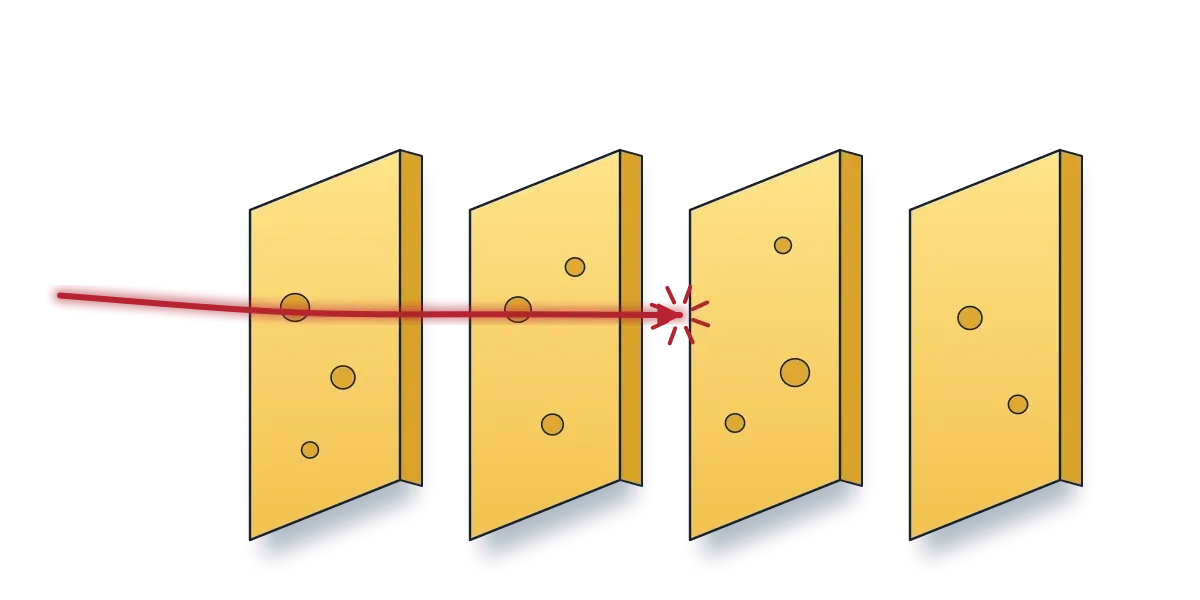
Picture the defenses against an accident as slices of Swiss cheese standing in a row: training is one slice, teamwork another, good management another. Each hole in a slice is a weakness in that defense. Most of the time a hole in one slice is covered by solid cheese in the next, so nothing gets through. An accident needs the holes in every slice to line up at the same moment.
The model changed how investigators work. Instead of stopping at the last person who touched the controls, they trace every slice back to its holes, because the latent ones will still be there for the next crew. That is why the findings in an investigation so often concern rosters, manuals and company culture, and it is what the recorders described in Why are black boxes orange? are retrieved to reveal. It is also why aviation prizes the honest report of a near miss, which is a hole found before anything lined up behind it.
How do planes avoid hitting each other?
The first layer is air traffic control, which assigns altitudes and routes so that aircraft stay separated; how controllers do that is explained in How does air traffic control work? The last layer is on board. Airliners carry TCAS, the traffic alert and collision avoidance system, as a safety net for the moment separation fails.
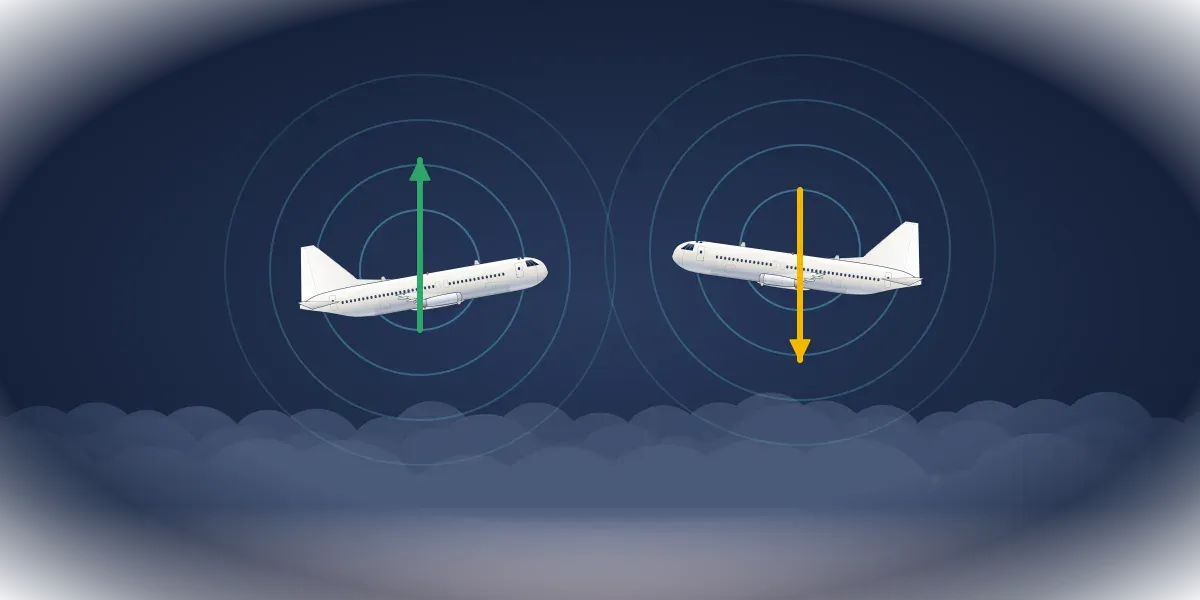
TCAS works by questioning the transponders of nearby aircraft, the same devices that answer ground radar. It cannot see an aircraft that has no transponder. From the replies it tracks everything close by, and if two aircraft are on a collision course it speaks up. First comes a traffic advisory, a warning to look. If the threat continues, each crew gets a resolution advisory: climb or descend. When both aircraft carry TCAS, the two systems coordinate by data link so that one is told to go up while the other goes down. The advisories are vertical because a quick change of altitude is the surest way to miss. In the United States, the FAA requires the system on airliners with more than 30 seats.
What happens if a plane engine fails over the ocean?
A twin-engine airliner can keep flying on one engine, and the rules assume it will divert to an airport if it has to. The question regulators have wrestled with for seventy years is how far from that airport a twin may stray.
In 1953, US rules kept two- and three-engine airliners within 60 minutes’ flying time of an adequate airport. Three-engine airplanes were released from the rule in 1964; twins were not. As jet engines proved themselves reliable, the FAA created ETOPS, approvals for extended twin-engine operations that an airline and an airplane type earn by meeting strict standards. A 1985 advisory circular allowed 120 minutes, and a 1988 revision allowed 180 minutes. The acronym has since been redefined as “extended operations,” because the same framework now applies to long over-water and polar routes for airplanes with any number of engines.
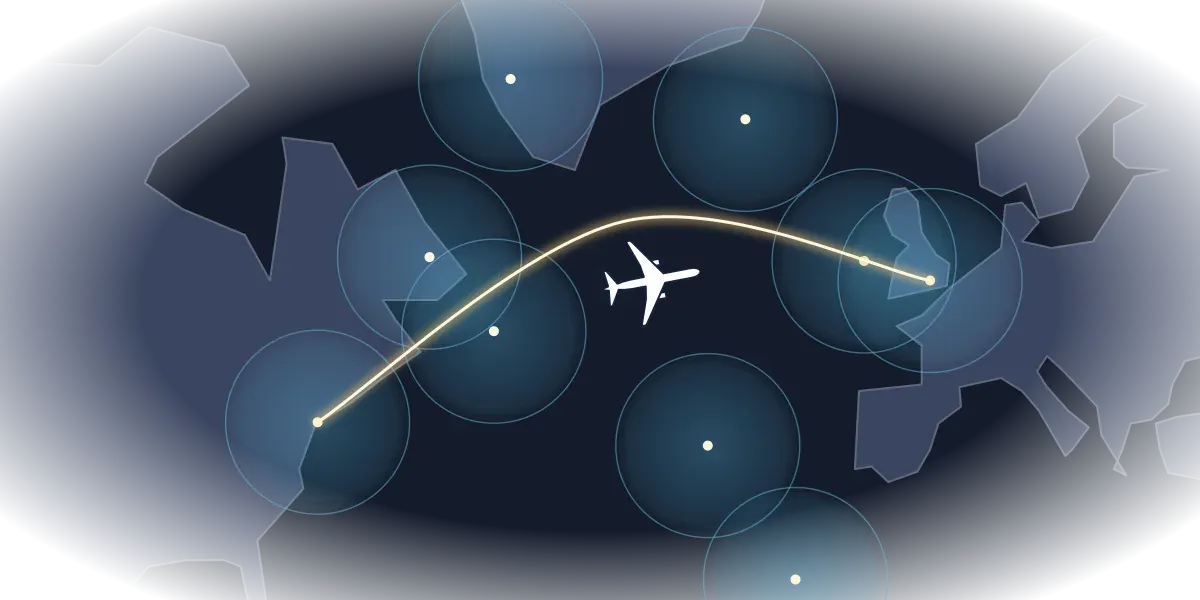
The limits kept growing. From 2000 the FAA granted 207-minute approvals across the North Pacific, and its 2008 circular describes 240-minute authority in polar and Pacific areas and, for a few operators, beyond 240 minutes. The Boeing 767 led the way in 1985 as the first twinjet on regular routes across the Atlantic. In 2009, Europe’s aviation safety agency cleared the Airbus A330 for ETOPS beyond 180 minutes, letting its routes stray up to 1,700 nautical miles, a little over four hours, from a suitable airport. The flight you see on the map arcing over the ocean is staying inside a corridor drawn around airports it could reach on one engine.
Why do pilots report their mistakes honestly?
Because the system is designed to make it safe to do so. Since 1976, NASA’s Aviation Safety Reporting System has taken confidential reports of unsafe events and near misses from pilots, controllers, cabin crew, mechanics and others. NASA runs it as an independent third party, not the regulator. Analysts strip out names and identifying details, then study the reports for hazards that no single person could have seen. The system has collected more than 2 million reports so far.
In Swiss cheese terms, each report is a hole discovered before anything lined up behind it. Patterns in the reports have led to changes in charts, airport layouts and the way clearances are worded, long before an accident forced the issue.
Why is flying so safe now?
Because the rules were rewritten after accidents, and the changes stayed. Four examples from the United States show the pattern.
In 1956, two airliners collided over the Grand Canyon. Both were outside controlled airspace, where controllers had no duty to keep them apart, and radar covered little beyond big airports. The public outcry helped create the Federal Aviation Agency in 1958 and sped up the modernization of air traffic control. Most controllers today guide aircraft they never see.
In 1978, a United Airlines DC-8 ran out of fuel near Portland, Oregon, while its crew focused on a landing gear problem. Investigators found that concerns about the fuel were not passed clearly to the captain. The lesson became crew resource management: training crews to work as a team and to speak up.
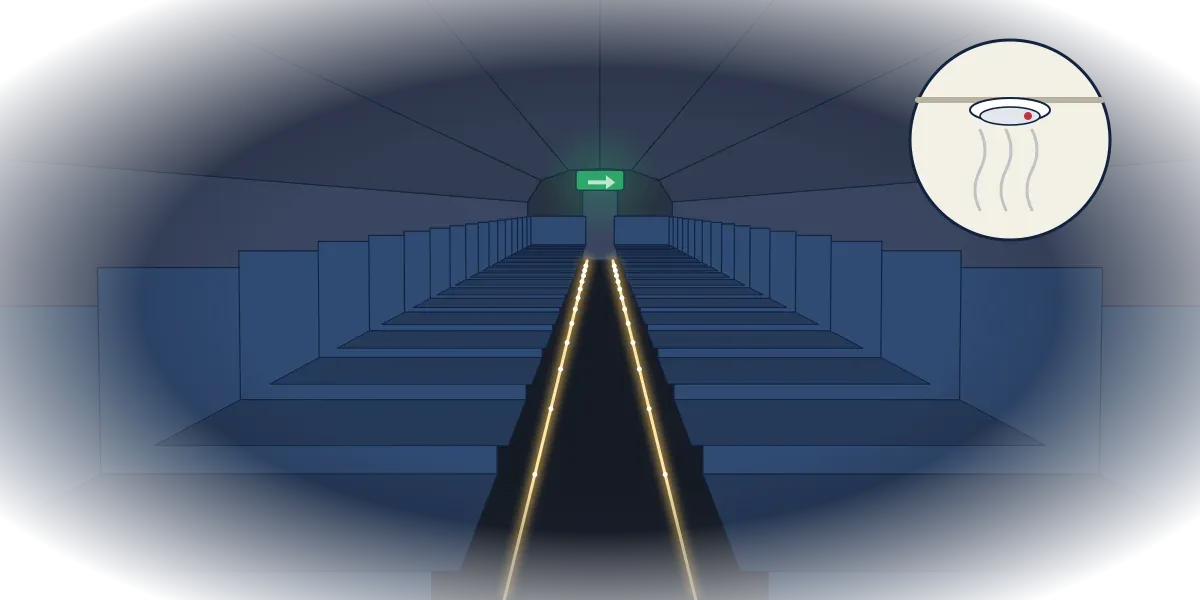
In 1983, a fire in the rear lavatory of an Air Canada DC-9 filled the cabin with smoke before the airplane landed at Cincinnati. The rules that followed are visible on every airliner today: smoke detectors in lavatories, automatic extinguishers in their trash bins, fire-resistant seat cushions and floor lighting that leads to the exits.
In 1988, a section of fuselage roof tore away from an Aloha Airlines Boeing 737 over Hawaii, and the crew landed safely on Maui. The jet had made 89,680 flights, and many tiny fatigue cracks along a fuselage joint had joined up. Since then, older jets get closer inspections, and new designs must prove in full-scale tests that such cracking will not appear. The earlier chapter of that story, the first jet airliner’s lessons about metal fatigue, is told in Why are airplane windows round?
None of this learning would be possible without evidence. Every airliner carries two flight recorders, mounted in the tail and built to survive a 3,400 g impact and a 1,100°C fire. A modern jet such as the Airbus A350, with an airframe that is 53 percent composites, is built under rules shaped by every one of these events, from fire-resistant cabins to fatigue standards.
What to watch for on your next flight
- The strip of lights along the aisle floor. It is there because of the 1983 Cincinnati fire, and the lavatory smoke detector sign is from the same set of rules.
- Two engines, and an ocean below. If your flight is a twin on a long over-water route, it is flying under ETOPS approval, within a set flying time of a diversion airport the whole way.
- The route on the seatback map. The arc across the ocean is partly the shortest path on a round Earth, and partly a corridor drawn around airports.
- The briefing before takeoff. The crew are one slice of cheese; the briefing is how they make you another.
- A bump in smooth air. It is the most common thing that happens on an airliner, and the records show the airplane is never the one at risk.
The record is extraordinary, but it was built one investigation at a time. How investigators get the evidence to start with is the story of the orange boxes in the tail: Why are black boxes orange?
Quiz
Check yourself
-
Question 1 of 3
In the Swiss cheese model of safety, what do the holes in each slice stand for?
- Weak spots in a defense
- Accidents that already happened
- Extra safety margins
- Airports along a route
Show the answer
Answer: A. Each slice is a defense such as training or teamwork, and each hole is a way that defense can fail.
-
Question 2 of 3
What does TCAS tell two aircraft on a collision course to do?
- Turn left or right
- Climb or descend
- Land at the nearest airport
- Speed up or slow down
Show the answer
Answer: B. TCAS gives vertical advice, and when both aircraft have it, they coordinate so one heads up while the other heads down.
-
Question 3 of 3
What did the 1978 Portland fuel-exhaustion accident help bring about?
- Automatic landing systems
- Flight data recorders
- Crew resource management training
- Fuel gauges in the passenger cabin
Show the answer
Answer: C. Investigators found fuel concerns weren't clearly passed to the captain, which spurred training in crew resource management.
Guides
Keep reading
Navigation & Weather
Is Turbulence Dangerous? What's Happening When the Plane Shakes
Safety & Lessons Learned
Why Are Black Boxes Orange? What Flight Recorders Do
The Jet Age
Why Are Airplane Windows Round? The Comet Story
Airports & Air Traffic Control
How Does Air Traffic Control Work? From the Tower to the Ocean
Aircraft
From the Hangar
Sources
- International Civil Aviation Organization, Safety Report 2026 Edition
- International Air Transport Association, IATA Releases 2025 Safety Report
- Federal Aviation Administration, Advisory Circular 120-72: Maintenance Resource Management Training
- Federal Aviation Administration, Introduction to TCAS II Version 7.1
- NASA, Aviation Safety Reporting System Overview
- Federal Aviation Administration, Advisory Circular 120-42B: Extended Operations (ETOPS and Polar Operations)
- Airbus, FAST magazine, special edition, October 2015
- Federal Aviation Administration, Lessons Learned: Grand Canyon midair collision
- National Transportation Safety Board, Aircraft Accident Report: United Airlines DC-8-61, Portland, Oregon
- Federal Aviation Administration, Lessons Learned: Air Canada DC-9-32, Cincinnati
- Federal Aviation Administration, Lessons Learned: Aloha Airlines 737-200, Hawaii
- National Transportation Safety Board, Cockpit Voice Recorders and Flight Data Recorders
- National Transportation Safety Board, Preventing Turbulence-Related Injuries in Air Carrier Operations Conducted Under Title 14 CFR Part 121 (SRR-21/01)