LEG 05 · Airports & Air Traffic Control
How Does Air Traffic Control Work? From the Tower to the Ocean
A relay of controllers hands every flight along like a baton, from the gate to 35,000 feet and back down again.
Updated · 7 min read
The short answer
Air traffic control is a relay. Ground and tower controllers handle the airport, approach and departure controllers manage the busy airspace around it, and en route centers watch flights in cruise, handing each one to the next facility by radio. Controllers keep airplanes apart by set distances, typically 3 to 5 miles sideways and 1,000 feet vertically.
Every airline flight you have taken was watched from the ground from the moment the engines started until they stopped. The watching is done by air traffic control: a relay of people in glass towers, dark radar rooms and windowless centers who pass each flight to one another like a baton. Most passengers never hear a word of it. Here is what the people with the headsets are doing.
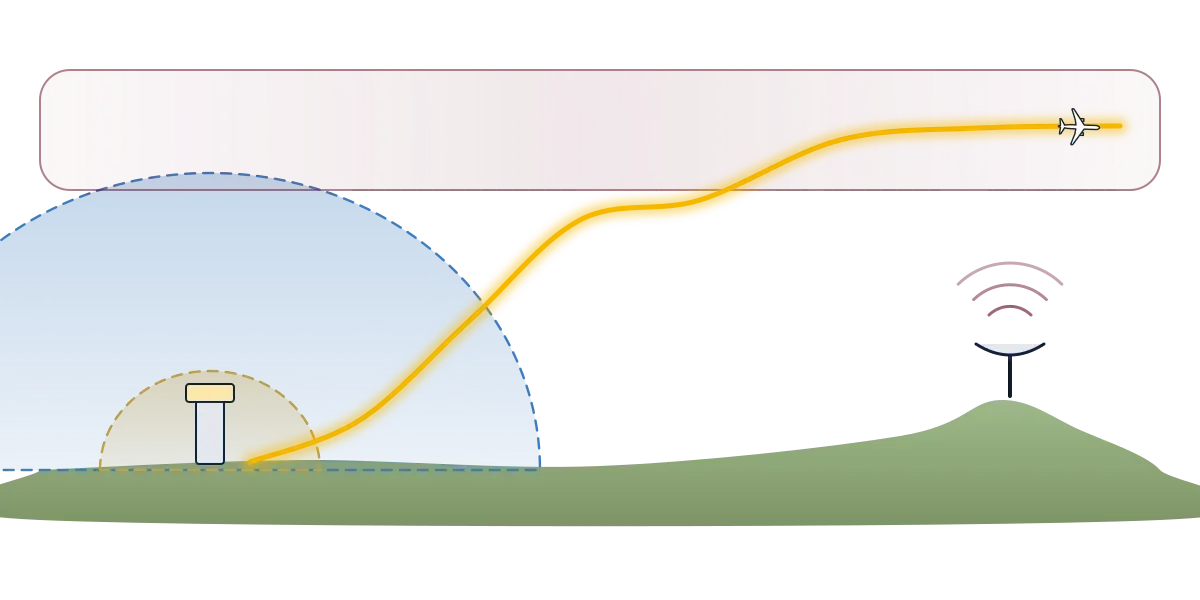
What does an air traffic controller do?
A controller’s job is separation: keeping airplanes a safe distance apart, in the air and on the ground, while moving as many of them as the system can hold. Controllers also sequence arrivals into an orderly line, issue the clearances that let a flight enter busy airspace, and pass on weather and traffic information. They do not fly the airplane. They tell the crew where to go, how high and how fast, and the crew does the flying.
The scale is enormous. The FAA’s Air Traffic Organization says it handles more than 44,000 flights and more than 3 million airline passengers on an average day, across more than 29 million square miles of airspace. In its 2024 fiscal year it logged 16.2 million flights, worked by 14,264 controllers.
How do air traffic control towers work?
The tower is the part you can see, and it handles the airport itself. Several positions share the work. Clearance delivery gives a departing flight its route before it moves. Ground control owns the taxiways, threading airplanes between the gates and the runway. The tower controller owns the runways and the air immediately around the field, and says the words every pilot waits for: cleared for takeoff.
The wind decides which runway numbers are in use, and the tower announces the choice. Not every airport has a tower. Of the 19,482 airports the FAA counted in 2024, only a few hundred have one. At the rest, pilots announce their position and intentions to one another on a shared radio frequency.
How many air traffic control centers are there in the US?
Once a flight climbs away from the airport, it passes to approach and departure control, usually a radar room called a TRACON that manages the crowded airspace around one or several airports. Above and beyond that, the en route centers take over. The FAA runs 21 air route traffic control centers, each responsible for a huge slice of the country, plus four combined facilities. A center hands a cruising flight from sector to sector, and then to the next center, all the way across the continent.
Add it up and the FAA counted 313 federal control facilities in 2024: 142 stand-alone towers, 25 stand-alone TRACONs, 121 buildings that combine a tower and a TRACON, and the centers. Another 264 smaller towers are run under contract. Each handoff along the way is a short ritual. The controller gives the crew a new frequency, the crew checks in with the next controller, and the previous one is finished with them.
What are the classes of airspace?
Controllers do not own every part of the sky equally. US airspace is divided into classes lettered A to G, and the letter says how much control applies. Class A runs from 18,000 feet up to 60,000 feet, and flights there normally have to be on an instrument flight plan under air traffic control. This is where airliners cruise, for the reasons Why do planes fly at 35,000 feet? explains. Class G, at the other extreme, is uncontrolled airspace, mostly close to the ground and away from airports.
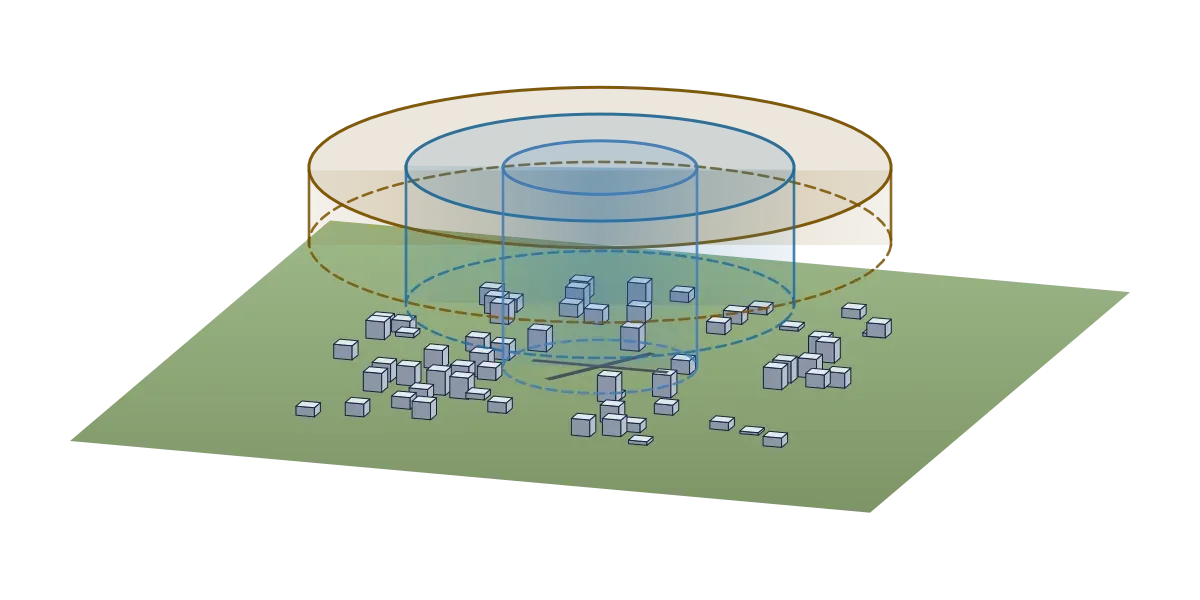
The busiest airports sit inside Class B, which stretches from the surface to 10,000 feet in layers that widen as they rise, a shape the FAA compares to an upside-down wedding cake. Every aircraft needs a controller’s clearance to enter it. Class C and Class D rings surround smaller airports with towers, and Class E fills most of the rest of the controlled sky.
How far apart do planes have to be in the air?
Closer than most passengers imagine, and farther than it looks from the window. Near airports, where the radar picture is sharpest, controllers keep airplanes at least 3 miles apart horizontally; more than 40 miles from the radar antenna the minimum grows to 5 miles. Vertically, the gap is measured in feet. Between 29,000 and 41,000 feet, in what is called RVSM airspace, approved aircraft are stacked just 1,000 feet apart, and an aircraft that is not approved for it gets 2,000 feet.
The stacking follows a simple rule. Flights on eastbound courses, from 0 to 179 degrees, use the odd flight levels, such as 35,000 feet. Flights heading west use the even ones. So the airliner you see sliding past 1,000 feet above you on a long flight is almost certainly going the other way.
What is wake turbulence?
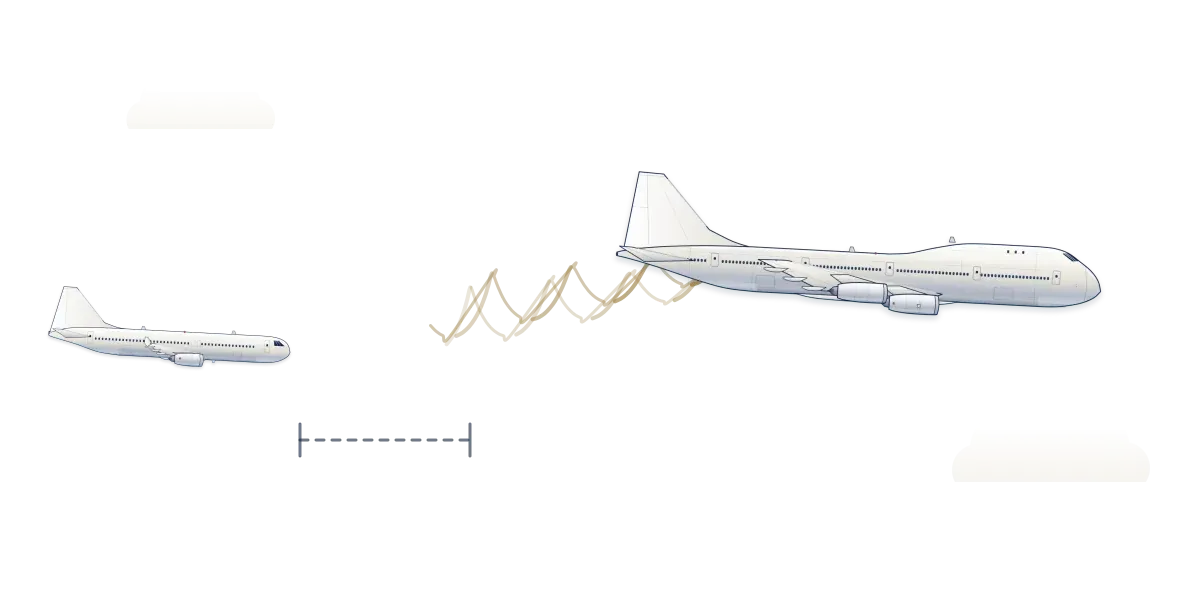
Every wing that makes lift sheds a pair of spinning vortices from its tips, and the heavier and slower the airplane, the stronger they are. Flight tests have shown that a large jet’s vortices sink at several hundred feet a minute, stay a little less than a wingspan apart and drift with the wind, weakening as they go. A small airplane that flies into them can be rolled hard, which is why controllers build extra space behind big jets.
The FAA sorts aircraft into four wake classes. Super is the Airbus A380. Heavy covers anything able to take off at 300,000 pounds or more. Large runs from 41,000 up to 300,000 pounds, and small is everything lighter. The spacing follows the classes: a heavy jet typically trails a super by 5 miles, a small airplane trails a heavy by 5 miles and a super by 8. The Boeing 757 earns its own line in the rules, with small aircraft kept 4 miles behind it. A wake is one of the few kinds of turbulence that spacing can avoid entirely, which Is turbulence dangerous? puts into context.
How do air traffic controllers track planes?
For most of the history of air traffic control the answer was radar: a rotating antenna that sweeps for echoes every 5 to 12 seconds and paints each return as a blip. Radar still works, but it only sees in straight lines, so mountains and distance leave gaps.
Today aircraft in most controlled US airspace are required to carry ADS-B Out, which does the job the other way around. Instead of waiting to be found, the airplane broadcasts its GPS position, altitude and ground speed once per second to ground stations and to other aircraft. Controllers get a faster and more precise picture, and the ground stations are small enough to go where no radar could. It is the same kind of data that feeds the flight-tracking apps on your phone.
How does air traffic control work over the ocean?
Out over the Atlantic and the Pacific there is no radar at all, and no ADS-B ground station either. The FAA says ICAO has delegated about 23 million square miles of ocean to the United States, worked from three oceanic centers at Oakland, New York and Anchorage. The agency’s own fact book puts the oceanic total at 24.1 million square miles, so the figure varies with the page. Either way it is far more sky than the 5.3 million square miles over the continent.
Without radar, control is procedural. Flights are cleared along routes at set altitudes and speeds, and controllers act only when something departs from the plan. Equipped aircraft report their position automatically over satellite data links and exchange typed messages with controllers; the rest talk to radio operators on long-range HF radio. With the satellite reporting in place, the FAA allows aircraft to be spaced 23 nautical miles apart side by side and 20 nautical miles nose to tail.
Why do pilots say niner?
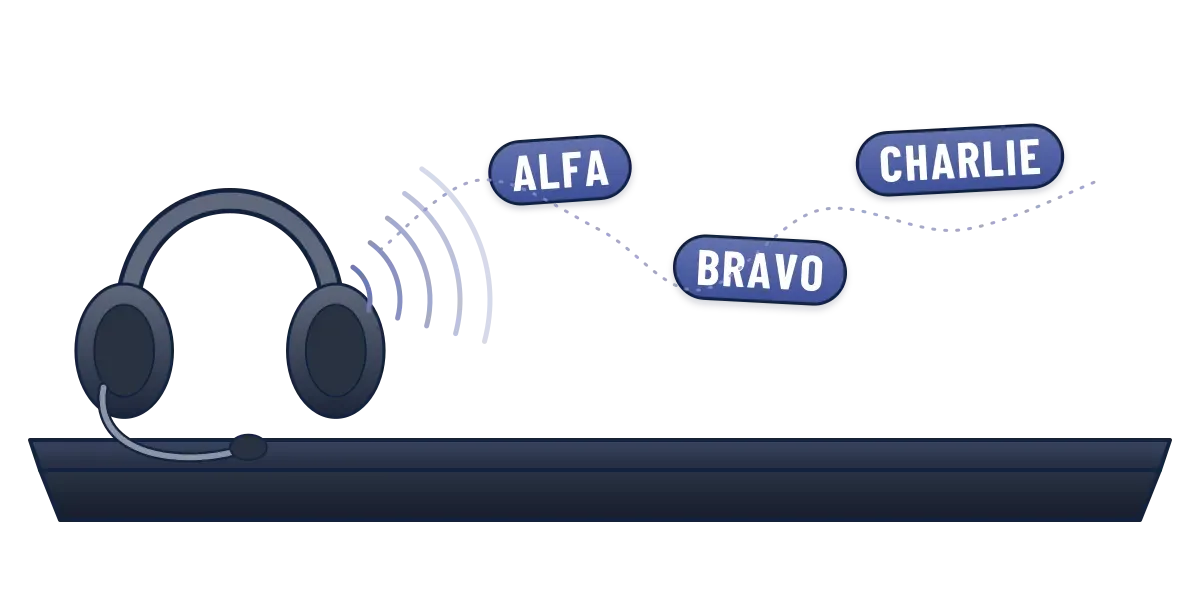
Because a radio channel is noisy, and a misheard digit matters. Aviation spells letters with the ICAO phonetic alphabet, Alfa through Zulu, and gives tricky numbers their own sounds: three becomes tree, five becomes fife and nine becomes niner, so that each digit stays distinct. Times are given in Coordinated Universal Time, called Zulu, so every controller and crew works from one clock. The whole alphabet is on our phonetic alphabet page.
Every flight also has a call sign. A private airplane uses its type and registration, as in Bonanza Six Five Five Golf. An airline flight uses its company call sign and flight number, and a big jet adds heavy or super so that everyone behind it knows about its wake. Air Force One is a call sign too, used for any Air Force aircraft with the president aboard, which today usually means one of the two VC-25As.
What to watch for on your next flight
You cannot see the controllers, but you can see their work.
- Before pushback, the crew has already received a clearance that spells out the whole route, which is one reason the doors close before the airplane moves.
- While taxiing, every turn was issued by ground control, and crossing a runway needs a specific clearance of its own.
- After takeoff, if your airline offers the air traffic control channel on the seatback audio, listen for the handoffs: a new frequency, a check-in, a new voice.
- In cruise, watch for opposite-direction traffic passing 1,000 feet above or below. Odd levels go one way, even levels the other.
- On approach, the gap to the airplane ahead is the wake rules made visible, and it grows when a heavy is in front.
The system looks invisible because it works. For the other codes that organize an airport, try Airport codes explained, and for the bigger picture of why all this care pays off, see How safe is flying?.
Quiz
Check yourself
-
Question 1 of 3
Which class of airspace surrounds the busiest US airports?
- Class B
- Class G
- Class A
- Class E
Show the answer
Answer: A. Class B airspace surrounds the busiest airports, reaching from the ground to 10,000 feet in widening layers.
-
Question 2 of 3
Which controllers look after flights cruising between cities?
- Ground controllers
- Clearance delivery
- En route centers
- Airport towers
Show the answer
Answer: C. Air route traffic control centers handle aircraft mainly during the en route part of a flight.
-
Question 3 of 3
Why might an airline flight add “heavy” to its call sign?
- It's running low on fuel
- It has a VIP passenger aboard
- It's a big jet with a strong wake
- It's carrying extra cargo today
Show the answer
Answer: C. “Heavy” and “super” tell controllers and other crews that the aircraft is in a large wake turbulence category.
Guides
Keep reading
Airports & Air Traffic Control
What Do Runway Numbers Mean? Headings, Letters and Stripes Explained
Airports & Air Traffic Control
Airport Codes Explained: Why Chicago Is ORD and Los Angeles Is LAX
Navigation & Weather
Is Turbulence Dangerous? What's Happening When the Plane Shakes
Navigation & Weather
Why Do Planes Fly at 35,000 Feet? Thin Air, Smooth Rides and Saved Fuel
Aircraft
From the Hangar
Sources
- Federal Aviation Administration, Aeronautical Information Manual: Controlled Airspace
- Federal Aviation Administration, Aeronautical Information Manual: Services Available to Pilots
- Federal Aviation Administration, Aeronautical Information Manual: Radio Communications Phraseology and Techniques
- Federal Aviation Administration, Aeronautical Information Manual: Wake Turbulence
- Federal Aviation Administration, Air Traffic By The Numbers
- Federal Aviation Administration, Air Traffic by the Numbers (FY2024)
- Federal Aviation Administration, Order JO 7110.65, Air Traffic Control: Radar Separation
- Federal Aviation Administration, Pilot/Controller Glossary: R
- Federal Aviation Administration, Pilot/Controller Glossary: A
- Federal Aviation Administration, Aeronautical Information Manual: Reduced Vertical Separation Minimum (RVSM)
- Federal Aviation Administration, ADS-B: Ins and Outs
- Federal Aviation Administration, Advanced Technologies & Oceanic Procedures (ATOP)
- Lockheed Martin, How the Constellation Became the Star of the Skies