LEG 05 · Airports & Air Traffic Control
What Do Runway Numbers Mean? Headings, Letters and Stripes Explained
The big painted numbers are compass headings in disguise, and they quietly change as the magnetic pole wanders.
Updated · 8 min read
The short answer
A runway's number is its magnetic compass heading divided by ten and rounded, so a runway pointing west, 270 degrees, is Runway 27. The opposite end is always 18 apart: Runway 9. Letters L, C and R separate parallel runways. White stripes mark the threshold, and yellow chevrons mark pavement that aircraft cannot use.
Look out of the window as your airplane turns onto the runway and you will see a big white number painted on the pavement, sometimes with a letter after it. It is not a count of the airport’s runways, and it is not a code. It is a compass heading in disguise. Once you can read it, you know which way you are about to fly, why one strip of pavement has two names, and why airports occasionally repaint their numbers.
How are runway numbers determined?
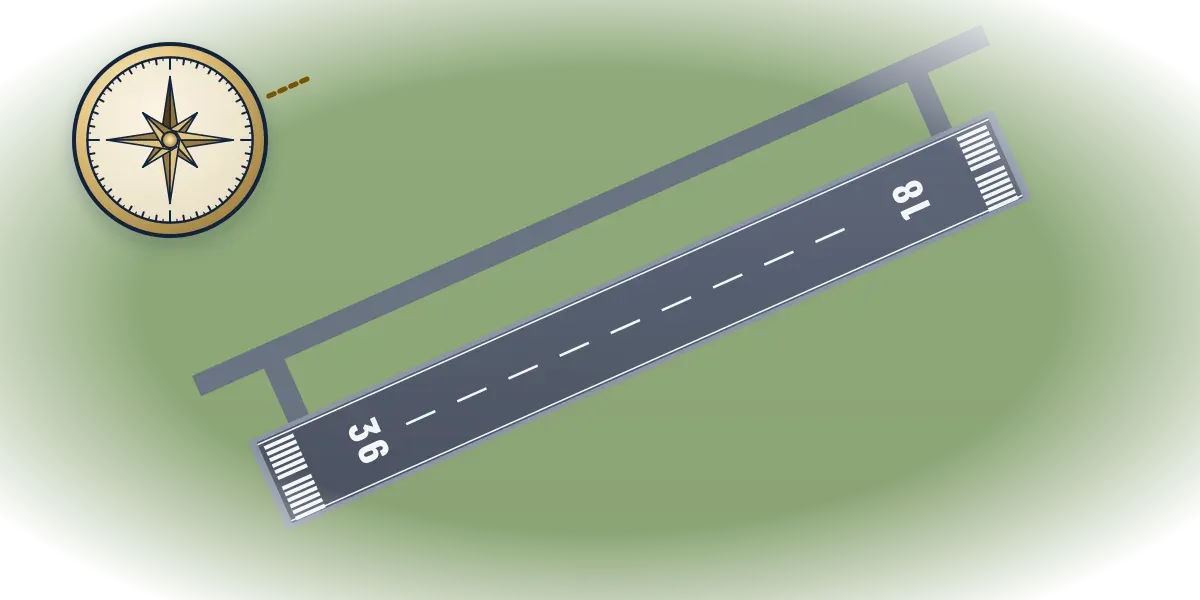
Every runway is named for the direction it points. Take the magnetic heading of its centerline, divide by ten and round to the nearest whole number. A runway aimed at magnetic north, 360 degrees, is Runway 36. One aimed east, at 90 degrees, is Runway 9, and one aimed at 270 degrees is Runway 27.
The FAA’s marking standard spells out the edge cases. A centerline at 183 degrees becomes Runway 18, and one at 87 degrees becomes Runway 9. A heading that ends in 5, such as 185 degrees, can round either way, so the airport chooses 18 or 19. And in the United States a single digit is never padded with a zero, which is why the paint says 9 rather than 09.
The numbers run clockwise from 1 to 36, just as a compass does, so there is no Runway 0: north is written as 36. Turn around by 180 degrees and the number changes by 18. The far end of Runway 9 is Runway 27, and the far end of Runway 36 is Runway 18.
Why do runways have two numbers?
One strip of pavement is really two runways, one for each direction. Airplanes take off and land into the wind whenever they can, because air flowing over the wings is what makes lift, as How do planes fly? explains, and a headwind supplies some of that airflow before the wheels have built up any speed. So when the wind swings around, the airport turns around with it. The pavement that worked as Runway 27 in the morning becomes Runway 9 in the afternoon.
That is why the red sign at a runway entrance reads 9-27 rather than a single number, and why pilots are cleared to a number rather than to “the long runway”. The number tells everyone the direction of travel. Which end is in use at any moment is decided in the tower, as How does air traffic control work? explains.
Are runway numbers true or magnetic?
Magnetic. The FAA’s Aeronautical Information Manual defines the number as the magnetic azimuth of the centerline, measured clockwise from magnetic north. That is deliberate. When a pilot lines up on Runway 27, the magnetic compass in the cockpit should read close to 270, so the number on the pavement and the number on the instrument agree.
Magnetic north and true north are not in the same place. The angle between them is called magnetic declination, or variation, and NOAA notes that it changes with both location and time. So a runway’s number depends on where on Earth it sits, not only on which way it points on a map.
Why do runway numbers change over time?
Because magnetic north wanders. Earth’s magnetic field shifts constantly, so the World Magnetic Model that compasses, phones and aircraft navigation systems rely on is rebuilt every five years to keep up. The current version, WMM2025, was released on December 17, 2024, and NOAA lists the FAA among the organizations that use it as their standard.
As a runway’s magnetic heading drifts, it eventually rounds to a different number, and the airport repaints. Tucson International Airport in Arizona did exactly that at the end of 2023: Runway 11L/29R became 12/30, and the crosswind runway 3/21 became 4/22. The airport authority’s notice adds that nearly every airport goes through this at some point, usually about once every 30 years.
A renumbering is more than a paint job. Every sign on the airfield, every marking and every published approach has to change on the same day, which is why airports often fold it into other construction work.
What do the L and R mean on runways?
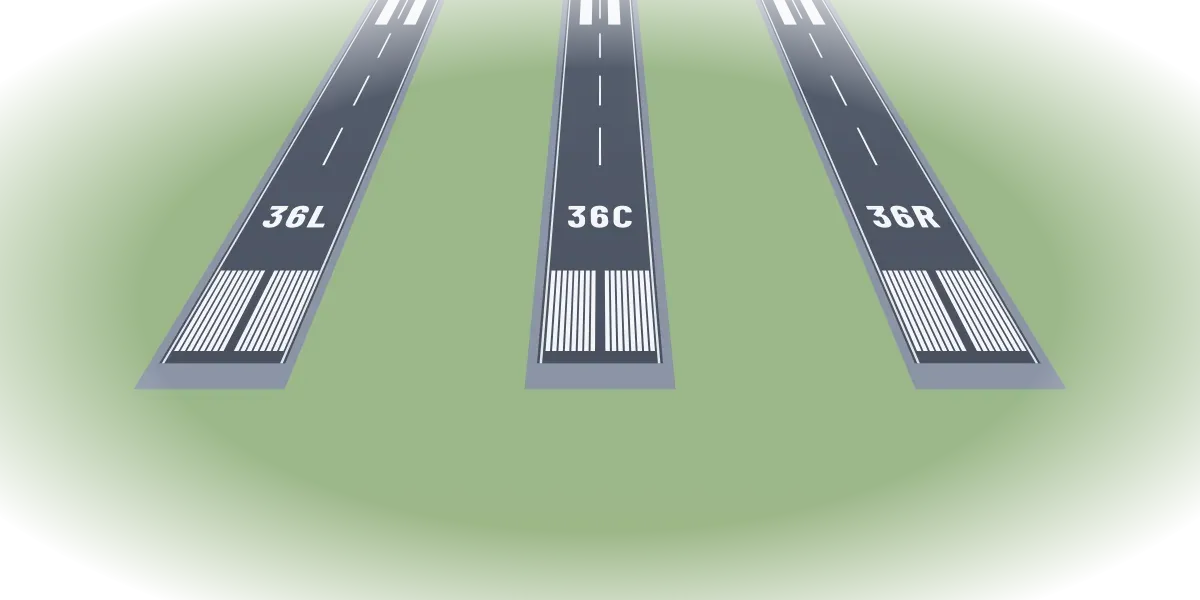
Busy airports build runways side by side so that several airplanes can land and depart at once. Parallel runways point the same way, so they share a number, and a letter tells them apart. Two parallels become 36L and 36R, left and right as seen from an airplane on approach. Three become 36L, 36C and 36R, with C for center.
The letters swap with direction. The runway that is 36L from the south is 18R from the north, because left and right are judged from the cockpit of the airplane that is landing. With four or more parallels, the FAA’s standard lets one pair take the next number along. Four runways at 324 degrees, for instance, are painted 32L, 32R, 33L and 33R, even though they all point the same way.
What do the stripes on a runway mean?
The white stripes across the start of a runway are the threshold marking: the line where the part of the runway available for landing begins. Many runways use a fixed set of eight stripes. On others the count encodes the width, from four stripes on a 60-foot runway up to sixteen on a 200-foot runway. A light airplane like the Piper J-3 Cub uses only a sliver of even the narrowest one.
A dashed centerline runs the full length of the runway. About 1,000 feet past the threshold come two broad white bars, the aiming point marking, which give a landing pilot a visual target. On runways with precision instrument approaches, groups of one, two and three narrower bars count down the touchdown zone in 500-foot steps, so a crew can judge how much runway has gone by.
Color is a code in itself. Runway markings are always white. Taxiway markings, including the holding-position lines where airplanes wait short of a runway, are yellow. If the paint under the nose is yellow, the airplane is not on a runway yet.
What is a displaced threshold?
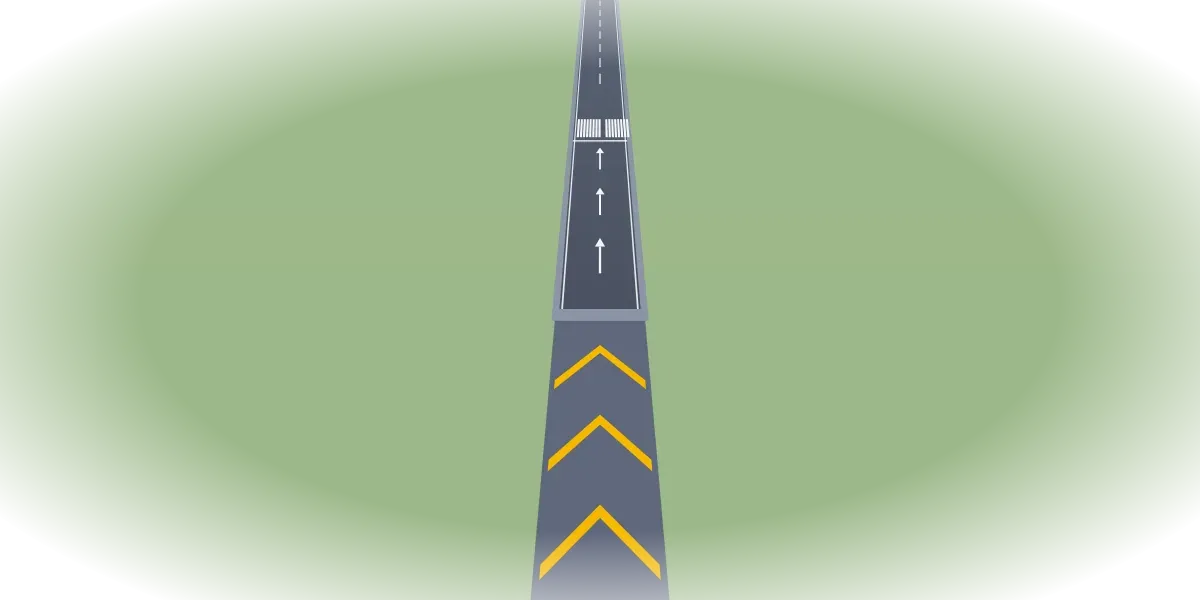
Sometimes the landing threshold is not at the beginning of the pavement. White arrows along the centerline lead up to a thick white bar: that is a displaced threshold, and airplanes landing in that direction touch down beyond the bar. The arrowed stretch is not wasted. It can be used for takeoffs, and by airplanes landing from the other direction as they roll out.
Displacing a threshold trades landing distance for clearance. Airports usually do it because of something near the runway end, such as a road, buildings or trees, that a landing airplane on its shallow descent needs to clear with room to spare. Moving the touchdown point farther in keeps the approach path above the obstacle.
Some airplanes are built with short, tight runways in mind. The four-engined BAe 146, whose maker highlights its steep-approach capability, was designed for city airports where the pavement is short and the obstacles are close.
What are the yellow chevrons before a runway?
Yellow chevrons pointing along the runway mean one thing: this pavement is not for landing, taking off or taxiing. It is often a blast pad, built so that jet exhaust does not erode the ground behind a departing airplane, or a stopway that exists only as a margin.
Chevrons also mark the cleverest piece of pavement at many airports: an arrestor bed called EMAS, short for engineered materials arresting system. It sits in the safety area beyond the runway end and is made of material that crushes under the weight of an airliner. If an airplane rolls off the end, its wheels sink in and the bed slows it rapidly, usually with little damage.
The FAA started the research in the 1990s for airports without room for a full safety area, which can be 500 feet wide and run 1,000 feet beyond each runway end. The first bed was installed at New York’s JFK in 1996. A standard installation stops most aircraft that enter it at 70 knots, about 80 mph. As of the FAA’s fact sheet dated August 2026, EMAS beds had safely stopped 26 overrunning aircraft carrying 497 people.
What do airport signs mean?
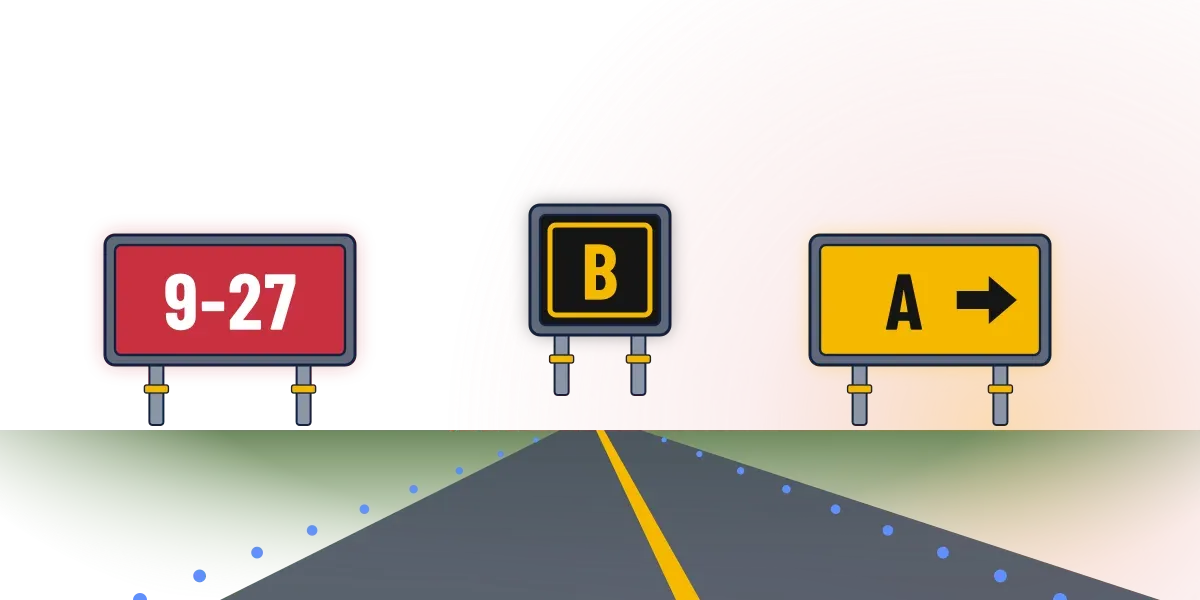
Signs follow a color code of their own. A red sign with white letters is a mandatory sign, and it marks the entrance to a runway or a place airplanes may not enter. The runway sign carries both numbers, arranged to match the ground: on a sign reading 9-27, the threshold of Runway 9 lies to the left and Runway 27 to the right.
A black sign with yellow letters is a location sign: it tells the crew which taxiway or runway they are on. A yellow sign with black letters and an arrow points the way to another taxiway. Between them, the three kinds of sign tell a crew where they are, what lies ahead and which way to turn.
After dark the same information turns into light. Runway edge lights are mostly white, taxiway edges glow blue and taxiway centerlines green. The airport’s rotating beacon flashes white and green for a land airport, and white and yellow for one on water.
What to watch for on your next flight
A window seat turns the runway into a readable page.
- Turning onto the runway, look for the red 9-27 style sign at the edge, then the big painted number ahead. Compare it with the direction you fly after takeoff.
- On the takeoff roll, the threshold stripes flash by first, then the two broad aiming bars about 1,000 feet in.
- On approach, with the flaps and slats fully out, watch the aiming bars grow: the airplane is heading for the pavement between them.
- Taxiing in, notice that the lines under the nose turn yellow once the airplane leaves the runway, and that blue lights edge the taxiways at night.
- At the far end, look for yellow chevrons beyond the last stripe. That pavement is off limits, and it may hide an arrestor bed.
Once the numbers make sense, the airport stops being a maze. Next, decode the three letters on your bag tag in Airport codes explained, or meet the people who choose which runway you use today in How does air traffic control work?.
Quiz
Check yourself
-
Question 1 of 3
A runway's centerline points to 270 degrees magnetic. What is its runway number?
- 2
- 27
- 270
- 7
Show the answer
Answer: B. Runway numbers are the magnetic direction divided by ten and rounded, so 270 degrees becomes Runway 27.
-
Question 2 of 3
Three parallel runways point the same way. How are they told apart?
- With the numbers 1, 2 and 3
- With flags at each end
- With different colored paint
- With the letters L, C and R
Show the answer
Answer: D. Parallel runways share a number and add L, C or R for left, center and right.
-
Question 3 of 3
What do two broad white bars about 1,000 feet down a runway mark?
- The best spot to leave the runway
- The point where takeoffs must begin
- The aiming point for landing
- A section closed for repairs
Show the answer
Answer: C. The aiming point marking gives landing pilots a visual target about 1,000 feet past the threshold.
Guides
Keep reading
Airports & Air Traffic Control
Airport Codes Explained: Why Chicago Is ORD and Los Angeles Is LAX
Airports & Air Traffic Control
How Does Air Traffic Control Work? From the Tower to the Ocean
How Flight Works
How Do Planes Fly? Lift, Thrust, Drag and Weight, Explained
Anatomy of an Airplane
What Are Those Moving Parts on the Wing? Flaps, Slats and Spoilers
Aircraft
From the Hangar
Sources
- Federal Aviation Administration, Aeronautical Information Manual: Airport Marking Aids and Signs
- Federal Aviation Administration, Standards for Airport Markings (AC 150/5340-1M)
- NOAA National Centers for Environmental Information, Magnetic Declination (Variation)
- NOAA National Centers for Environmental Information, World Magnetic Model (WMM)
- NOAA National Centers for Environmental Information, World Magnetic Model 2025 Released
- Tucson Airport Authority (notice hosted by the FAA), Airfield Changes
- Federal Aviation Administration, Engineered Material Arresting System (EMAS)
- Federal Aviation Administration, Aeronautical Information Manual: Airport Lighting Aids